
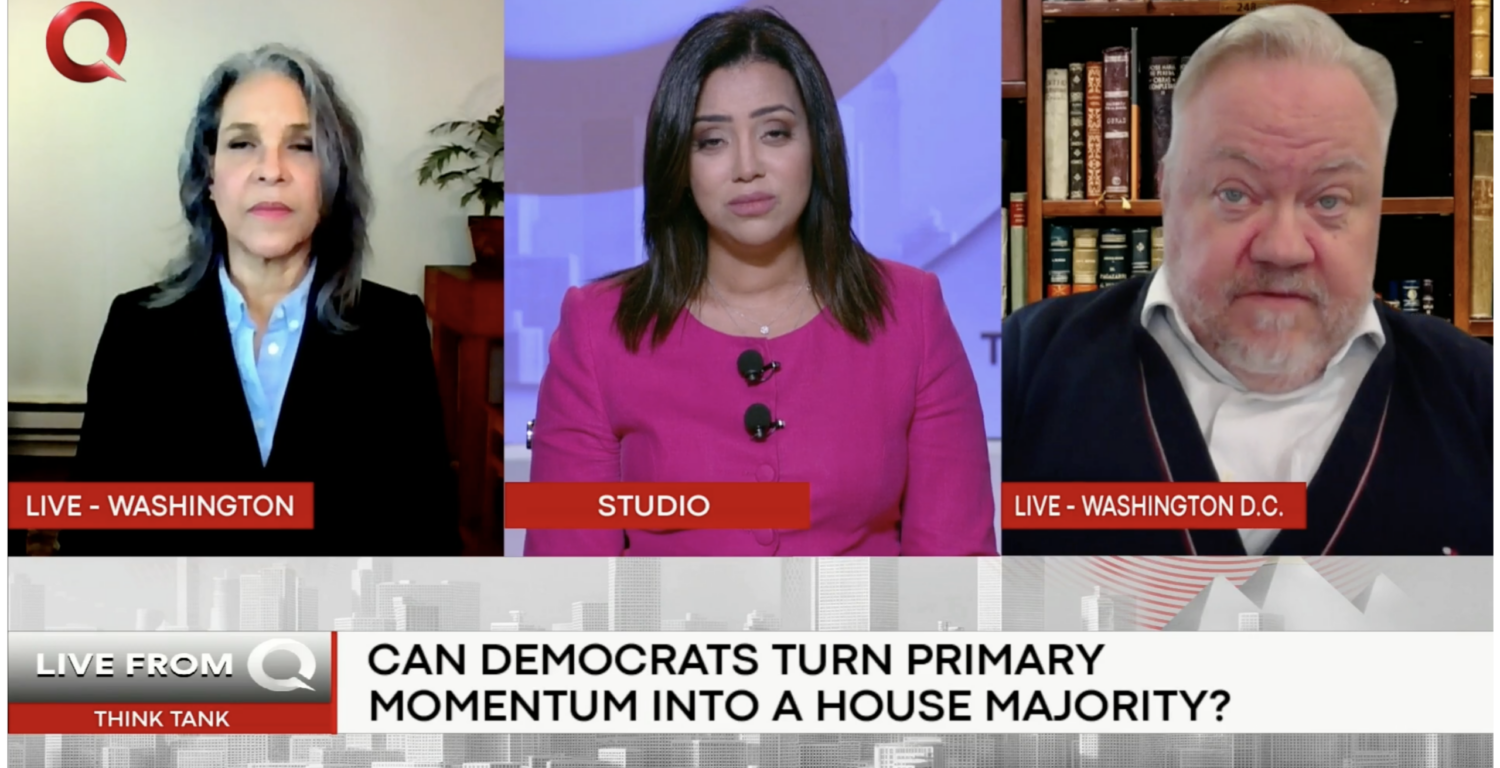

On August 13, 2026, investigative journalist Matthew Vadum appeared on the Egyptian channel QNews’ Think Tank program to discuss the 2026 U.S. midterm landscape. Hosted by Reham Morsi, the segment examined whether President Donald Trump’s grip on Republican primaries is weakening, the significance of progressive victories inside the Democratic Party, and the prospects for a divided Congress.
Watch the full segment here:
Vadum was joined by political analyst Ginger Chapman. The conversation focused on what the primary season reveals about the direction of both parties ahead of November.
The Democratic Left’s Advance
Vadum described a long-running leftward shift within the Democratic Party that has accelerated in recent years. He traced the trend back decades while noting its current intensity.
“The far-left has been taking over the Democratic Party since at least George McGovern’s unsuccessful run for president against Richard Nixon in 1972. The pace has accelerated in recent years,” Vadum said.
He pointed to concrete primary results as evidence. In June, New York City Mayor Zohran Mamdani endorsed three progressive candidates who swept House primaries. Two of them defeated sitting incumbents, including the chairman of the Congressional Hispanic Caucus. Similar progressive victories occurred in Colorado, Michigan, and other deep-blue areas.
These wins, Vadum argued, show the party’s activist base successfully pushing left on issues including Israel and Gaza, immigration enforcement, and economic populism. “It shows that the establishment in the Democratic House leadership, traditional labor unions and pro-Israel donors are now weaker than they were a few years ago when more moderate candidates usually prevailed,” he said.
At the same time, he cautioned against overreading the results. Most of these contests took place in safe Democratic districts. “This is significant for the Democratic party’s internal identity and future presidential primaries. It doesn’t necessarily translate into general election wins in competitive districts,” Vadum noted.
Trump’s Influence and Its Limits
On the Republican side, the discussion turned to Trump’s continued dominance in primaries. While his endorsements remain highly influential, recent results show they are not always decisive. Some Trump-backed candidates have lost, raising questions about how well primary strength will translate to the general electorate, particularly among independents and suburban voters.
Chapman observed an anti-incumbent mood and a generational divide on both sides of the aisle. Younger voters, she said, are increasingly breaking from party establishments. Independents have also grown more powerful as a decisive voting bloc.
The Path to November
The House remains the more competitive chamber for Democrats, who need only a relatively small net gain to reclaim the majority. The Senate map continues to favor Republicans, making a Democratic takeover there more difficult. That imbalance raises the real possibility of a divided Congress—Democrats controlling the House while Republicans retain the Senate.
Such an outcome would constrain Trump’s legislative agenda in the second half of his term while strengthening the role of congressional investigations and oversight.
The primaries, Vadum and Chapman agreed, are offering early clues rather than a clear national realignment. Both parties are navigating internal tensions even as the country remains deeply polarized. The results in November will test whether progressive energy on the Democratic side and Trump’s primary power on the Republican side can be converted into governing majorities—or whether voters deliver a split verdict that checks both.