

Trump’s gas-price messaging and the Houthi threat to Bab al-Mandeb
Investigative journalist and author Matthew Vadum appeared on NewsX World on August 14, 2026 (August 15 in India) to discuss President Donald Trump’s recent comments on elevated gasoline prices and the escalating threat posed by Yemen’s Houthi rebels to the strategic Bab al-Mandeb Strait. The anchor was Keren Nanyaro.
Vadum addressed Trump’s remarks from a New York rally in which the president described higher gas prices—then averaging around $4 per gallon—as “okay” and declared he would “never apologize” for them, framing the increase as the necessary cost of preventing Iran from obtaining a nuclear weapon.
Vadum supported the underlying strategic objective while criticizing the public messaging. “Trump is being straightforward about the trade-off,” he said. “Higher prices are the cost of confronting Iran. That’s a legitimate argument. The problem is the delivery. Telling people ‘it’s okay’ and ‘I’ll never apologize’ while they’re paying around four dollars a gallon comes across as callous.”
He noted the inconsistency with other administration statements, including Vice President JD Vance’s description of keeping oil and gas cheap as “goal number one.” Vadum argued that policymakers can defend the Iran campaign without appearing indifferent to the real financial pressure on American households.
Turning to the Red Sea, Vadum backed Yemen’s foreign minister-designate, who warned that the Iran-backed Houthis must not be allowed to hold the Bab al-Mandeb Strait hostage. The Houthis have declared a maritime blockade targeting Saudi shipping and have carried out attacks that raise costs and risks for vessels using the critical chokepoint linking the Red Sea to the Gulf of Aden.
“Yemen’s foreign minister is right,” Vadum said. “The Houthis cannot be allowed to hold the Bab al-Mandeb Strait hostage. They’re trying to copy Iran’s Hormuz playbook—using a second vital waterway for leverage. With Hormuz already disrupted, threatening the Red Sea route creates another major pressure point on global trade and energy.”
He criticized the international response as insufficient and warned that permitting an Iranian proxy to weaponize another key shipping lane would impose lasting costs on commercial navigation and energy markets worldwide.
Video:
Yemen escalation and Lebanon tensions
Investigative journalist and author Matthew Vadum appeared on NewsX World late on August 15 / early August 16, 2026, to discuss the sharp escalation in Yemen, where Houthi forces launched multiple ballistic missiles at the government-held city of Marib, endangering residential areas and camps for internally displaced persons, alongside strikes affecting the Red Sea port of Mocha. The segment also covered Israeli strikes in southern Lebanon. The anchor was Asuma Kataoka. The other guest was Professor Ernesto Castañeda of American University.
Vadum linked the Yemen fighting to the wider U.S.-Israel-Iran conflict. “It’s probably a serious thing what’s going on in Yemen,” he said. “The escalation there has something to do with the wider US-Israel-Iran war. The Houthis have, as I understand it, stepped up as an Iranian proxy… and they are attacking both Yemeni government forces and Saudi targets while also hitting shipping.”
He noted that the internationally recognized Yemeni government and Saudi-led side had responded in a relatively restrained fashion so far, but tensions remained high. “The Houthis are breaking the long truce and risking a return to a full civil war, while also hitting Saudi energy and Red Sea shipping. And this fits the pattern of Iran trying to expand the war, opening it up on new fronts. So, yeah, there’s reason to be concerned.”
On the Lebanon track, the panel discussed the fragility of U.S.-brokered efforts amid continued violence. Vadum remained on the panel as the conversation turned to mediation challenges and Israeli and Lebanese positions.
Video:
Kushner-Hamas meeting and Iran military posture
Investigative journalist and author Matthew Vadum appeared on NewsX World late August 16 / August 17, 2026, discussing reports that U.S. envoy Jared Kushner had met Hamas political leader Khalil al-Hayya and other senior figures in Egypt in an effort to revive a stalled Gaza roadmap, as well as signals from Iran’s Islamic Revolutionary Guard Corps about a possible shift toward a more offensive military doctrine. Other guests included Daniel Wagner, CEO of Country Risk Solutions.
Vadum assessed the Gaza talks skeptically, emphasizing core obstacles that predated Kushner’s involvement. He stressed Israel’s insistence on pursuing the perpetrators of the October 7, 2023, massacre—the worst mass killing of Jews since the Holocaust—and Hamas’s resistance to that demand. He described the overall outlook for the peace process as mixed and uncertain, noting that such Middle East negotiations often strike him as largely pointless.
On Iran’s doctrinal comments, the panel examined whether Tehran retained the capacity for a more aggressive posture after months of conflict that had severely damaged its navy and other capabilities, and what that might mean for pressure on waterways including Bab al-Mandeb.
Video:
Gaza strike and stalled Trump peace plan
Investigative journalist and author Matthew Vadum appeared on NewsX World late on August 18, 2026, discussing an Israeli strike on a Gaza City café that killed at least six people and injured 14, according to hospital officials, as well as the lack of breakthrough in U.S. envoy Jared Kushner’s regional efforts on a 15-point Gaza peace plan. The other guest was Erik Lehmkuhle.
Vadum described the outlook for the peace plan as “iffy” and uncertain. He identified the core sticking point: “Israel still wants to hunt down the perpetrators of the October 7th, 2023 massacre… this was the worst massacre of Jews since the Nazi Holocaust. And Israel insists on being able to go after the perpetrators… Hamas is not happy about this… Israel’s saying we reserve the right to go after these people.”
He added that Kushner’s appearance was unlikely to produce sudden harmony: “I don’t think that the appearance of Jared Kushner is suddenly going to make everybody link arms and sing Kumbaya… the outlook on this remains mixed… this is my feeling about most peace negotiations on conflicts in the Middle East. They strike me as pointless and this is no exception.”
Video:
Trump signals possible Iran talks while demanding nuclear disarmament
Investigative journalist and author Matthew Vadum appeared on NewsX World on August 19, 2026, discussing President Donald Trump’s shifting signals on possible U.S.-Iran negotiations, his continued demand that Iran fully abandon nuclear weapons capability, and claims of U.S. control over the Strait of Hormuz. The anchor was Asuma Kataoka. Other guests included geopolitical strategist John Rossomando (appearing in related segments of the broadcast).
The discussion covered Trump’s comments that negotiations “may restart maybe at some point,” his assertion that the situation with Iran was currently favorable, and the broader context of the expired memorandum of understanding, continued tensions over Hormuz, and Iranian communications via Oman.
Video:
U.S. national debt surpasses $40 trillion
Investigative journalist and author Matthew Vadum appeared on NewsX World on the evening of August 19, 2026 (airing into August 20 in some time zones), discussing the U.S. national debt crossing the $40 trillion mark for the first time, according to Treasury figures. The broadcast also touched related fiscal and policy issues.
Vadum called the figure “an incomprehensibly large” sum and said the debt already constitutes a genuine threat to U.S. economic stability. “I’d say it’s a threat to the United States right now. It has been for some time… it’s a problem now and it’s only going to get worse because right now both President Trump and Congress have expressed no interest in cutting back and they won’t address the main cost drivers… the long-running growth of Social Security and Medicare programs, high interest costs on existing debt.”
He pointed to pandemic-era spending under both the first Trump administration and the Biden administration that never returned to prior levels, ongoing defense and military outlays including the Iran conflict, proposed Pentagon budget increases, tariff refunds following a Supreme Court setback, and the structural mismatch between spending and revenue. “There’s no market for spending cuts in Washington… you don’t get buildings named after you or statues or prizes for cutting spending… it’s a vicious cycle… one day Americans are going to have to face up to its reckless spending. And it won’t be pretty.”
Video:
Strait of Hormuz shipping, U.S. blockade claims, and energy leverage
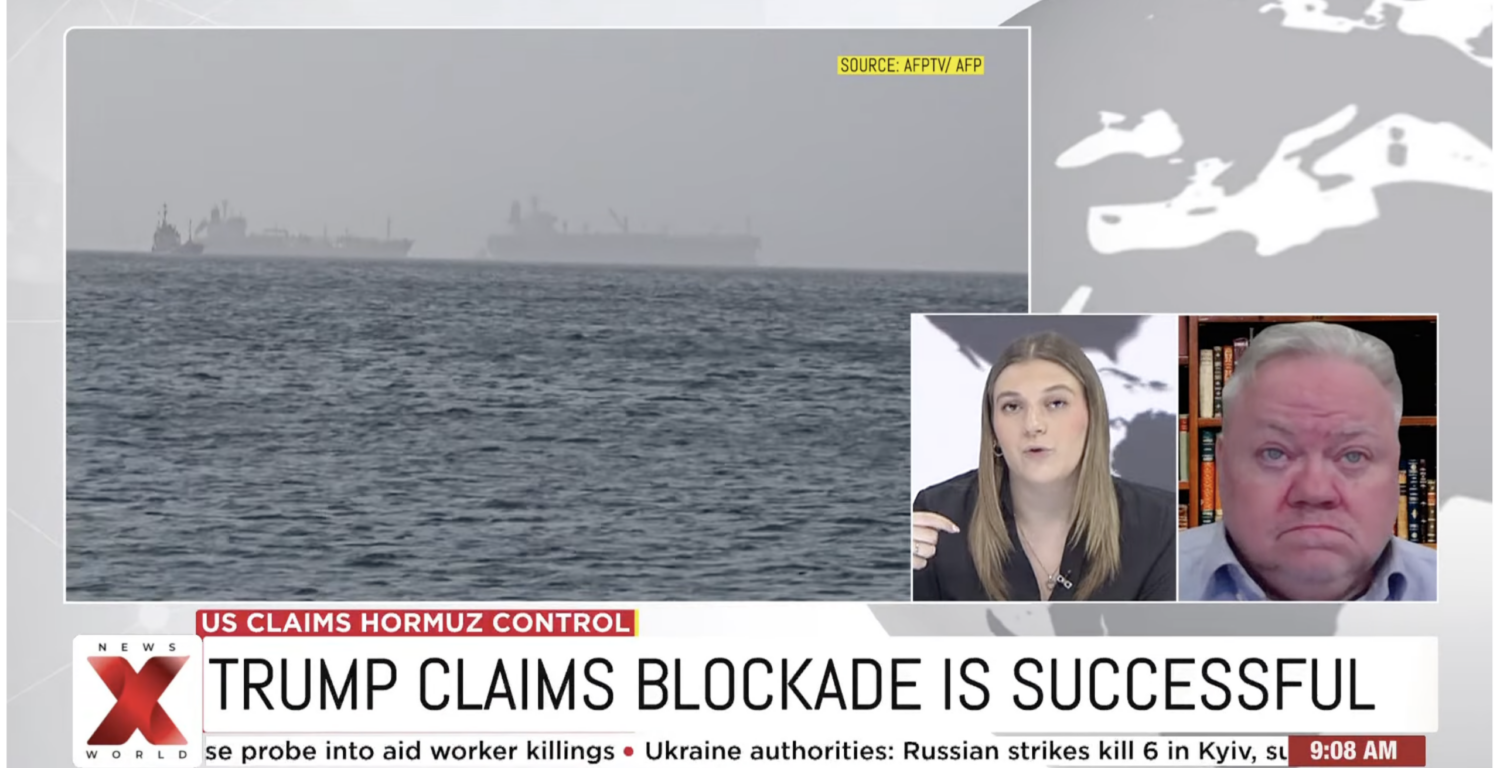
Investigative journalist and author Matthew Vadum appeared on NewsX World on the evening of August 19, 2026, discussing President Trump’s claims that the Strait of Hormuz remains open with a “100% successful” U.S. naval blockade, Iranian counter-claims of restricted access, actual shipping volumes, and whether rising U.S. domestic oil production reduces American vulnerability. The anchor was Ellie Richardson.
On the state of commercial shipping, Vadum said roughly 5 million barrels of oil per day were getting through, compared with about 15 million barrels per day before the war. “That’s a partially successful blockade but… I personally wouldn’t describe that as a success although President Trump is saying it’s a success because he wants to reassure markets and he doesn’t want the price of oil to skyrocket… it’s been a partial success but… President Trump has been exaggerating just how successful it’s been.”
He assessed leverage as difficult to judge: “If the United States continues pressing Iran, then it will gain the upper hand if its measures work. But the Iranians… discovered early on… that putting the squeeze on ship traffic in the Strait of Hormuz was the key to manipulating Americans… they’re not going to give up on that tactic because it’s been so successful for them so far.”
On U.S. energy independence versus global price effects, Vadum noted that the United States has long been effectively energy independent and does not depend on Hormuz for its own oil shipments. “The problem though is that oil is a worldwide commodity. So if the supply is getting squeezed and 20% of the world’s supply of oil supposedly goes through the Strait of Hormuz that has an effect on the price worldwide… it forces the price up.”
Video:
ICE-Iran deportation coordination and fresh U.S. sanctions on Hezbollah
Investigative journalist and author Matthew Vadum appeared on NewsX World on the evening of August 20, 2026, to discuss two developments: newly released emails showing coordination between U.S. Immigration and Customs Enforcement (ICE) and Iranian officials over the deportation of more than 100 Iranians, and fresh U.S. sanctions targeting Hezbollah while redesignating the group for its service to the Iranian regime. The anchor was Ellie Richardson.
On the deportations, emails obtained by the National Iranian American Council through a Freedom of Information Act request and legal action revealed that ICE worked with Iranian officials to arrange three flights between September 2025 and January 2026. Iranian officials reportedly had influence over the lists, requesting additions and last-minute changes. The coordination occurred despite heightened U.S.-Iran tensions, including the 12-day war in June 2025. DHS and ICE denied sharing confidential asylum information and said the removals followed due process.
Vadum noted that some level of cooperation between a deporting country and a receiving country is always required, since the receiving country can refuse deportees, as has sometimes happened with China and Cuba. Even without full diplomatic relations, Iran maintains an interest section in the Pakistani embassy in Washington that handles consular matters. “Are there safeguards? Not a lot really,” he said. The main safeguard is access to the U.S. court system, including immigration court and, in some cases, federal habeas corpus petitions. Many of those deported had already had asylum claims rejected and thus received due process. He predicted civil libertarian groups such as the ACLU would likely raise concerns and possibly seek a congressional inquiry or lawsuits. “It’s a messy situation. The deportation process isn’t nice, but it looks like they took care of it with Iranian cooperation. Iran went along with it presumably because Iran wants to appear strong. They want to have their own citizens back and so they consider it as doing their patriotic duty to get their people back.”
Asked what the quiet channel revealed about practical cooperation amid open hostility, Vadum replied that the two sides still talk when it is practical. The United States wanted to remove people it deemed lawbreakers, visa overstayers, or criminals; Iran wanted to appear to be doing the right thing by expediting their return. He compared it to residual contacts even during the U.S. war against the Taliban: “The two sides still talk and that was the case even when the United States was waging war against the Taliban, a terrorist regime in Afghanistan—there still would be some level of contact between the two governments even though they hated each other [and] were trying to kill each other.”
Turning to Hezbollah, the United States imposed new sanctions and redesignated the group “for service to the Iranian regime under the command of Iran’s Islamic Revolutionary Guard Corps-Quds Force.” Officials said the move clarifies that Hezbollah acts as an Iranian proxy rather than an independent organization. The action targeted a financial network of 10 individuals accused of moving hundreds of millions of dollars via couriers, exchange houses, front companies, and accounts across Lebanon, Turkey, the UAE, and Iran outside formal banking channels.
Vadum said the redesignation gives American authorities a freer hand. “I think that the redesignation gives American authorities a freer hand to punish Hezbollah by recognizing that it is essentially a vassal of Iran. It is an instrumentality of Iran. It is doing Iran’s bidding. It is subordinate to Iran. Basically, it’s just an extension of Iran… This will give the U.S. State Department greater authority to levy sanctions against the organization, against people who do business with it, against financial institutions that deal with Hezbollah and its money… it just gives the U.S. more authority, a freer hand to deal with Hezbollah.” He noted Hezbollah has been designated a foreign terrorist organization since 1997; the new action clarifies its status as operating under IRGC-Quds Force command. He described the IRGC as “kind of like the Nazi SS” in the Iranian system given its many divisions and directorates, adding that Hezbollah does not respect Lebanese sovereignty but exists to do Iran’s bidding.
On the difficulty of disrupting the cash-smuggling networks without further straining Lebanon’s fragile financial system, Vadum said it would be very difficult and would complicate matters for Lebanese authorities and the banking system. “It definitely makes it more difficult for Lebanese authorities to operate without worrying that they’re going to run afoul of the latest U.S. sanctions or penalties that are being applied to Hezbollah.” He linked the move to the broader pressure campaign led by Treasury Secretary Scott Bessent, who has warned those doing business with Iran that the United States is coming after them.
Video: