
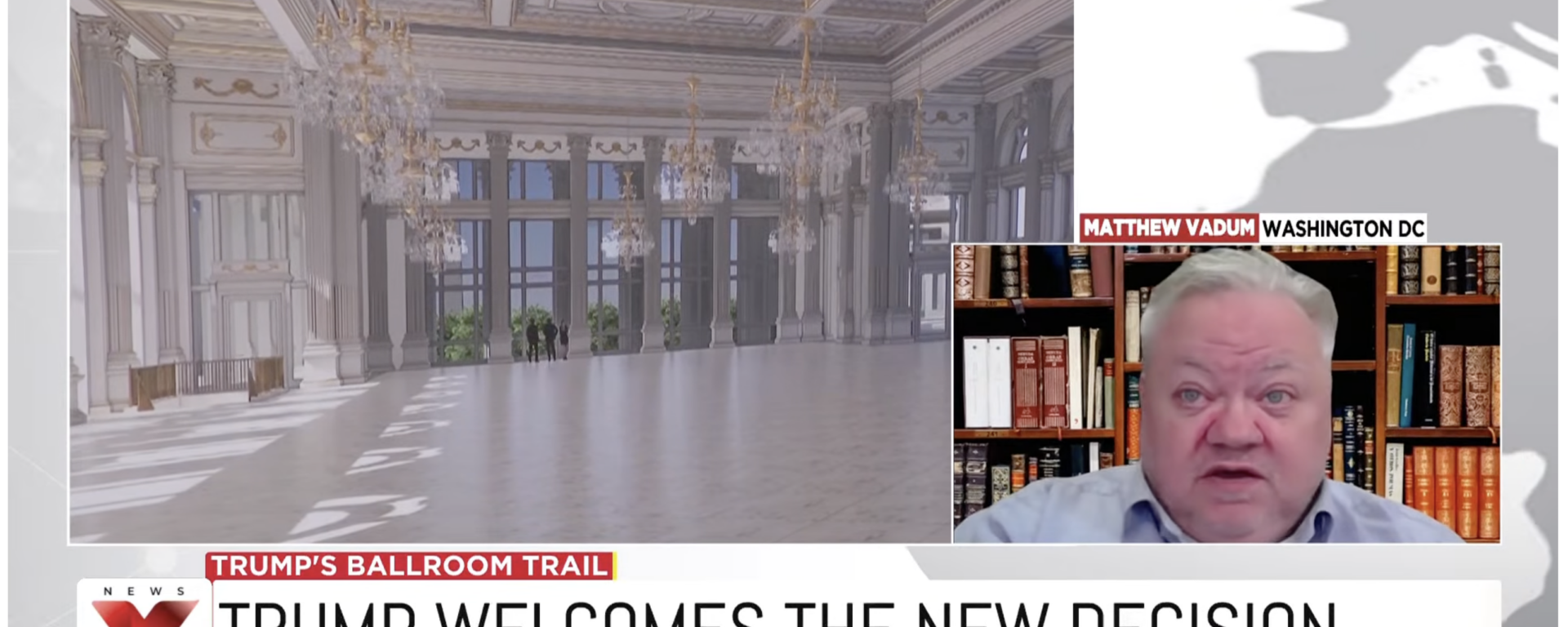

Investigative journalist and author Matthew Vadum appeared on NewsX World in India on August 22, 2026, discussing Iran’s threats over the Strait of Hormuz, four kites found near the Israeli border community of Nahal Oz, and Chief Justice John Roberts’ temporary stay allowing construction of the White House East Wing ballroom and security complex to continue.
The anchor was Asuma Kataoka. The other guest was retired Indian Army Major General Sudhakar Jee.
The full segment is available here:
On relative risks to shipping through the Strait of Hormuz, Vadum said:
“Well, the US has attacked some vessels by mistake, but this is pretty minor on the overall ledger sheet. Iran is the one that aggressively and deliberately attacks ships. When the United States does it, it is in error. So I think that any rational shipping company would be much more fearful of Iran than the United States. The United States is trying to enforce a blockade and does what it thinks is necessary. Iran indiscriminately attacks shipping in order to inflict terror. It wants companies to be afraid of shipping their oil and other products, natural gas, and what have you through the Strait of Hormuz because it gives Iran leverage. It gives Iran power and influence internationally. And this is something that the Iranians crave. So I don’t most rational actors are afraid of the United States here. They’re right to be afraid of Iran.”
On the “economic D-Day” / maximum-pressure strategy of the United States and the practical limits of confronting every country that trades with Iran, he said the United States has taken some action against such countries but that taking on the entire world “is too tall an order even for the Trump administration.” He expected a more limited response focused primarily on those who benefit most directly from trade with Iran.
Turning to the four kites that the IDF found crossing over the border into Israel, Vadum noted that Israel is right to remain on alert, recalling the 2018 incendiary-kite attacks. He said Hamas may be testing Israel.
He also addressed settler violence and the constraints facing Prime Minister Netanyahu’s coalition government in the Knesset, which depends on support from ultra-religious parties.
Later in the same appearance (beginning around the 25:28 mark), the discussion shifted to the Supreme Court’s action on the White House ballroom project. Chief Justice John Roberts issued an administrative stay of a lower-court order that would have halted much of the above-ground construction. Vadum explained:
“Well, what happened here is that on Friday, the Chief Justice of the United States, the head of the Supreme Court, John Roberts, issued what’s called an administrative stay of a lower court order that blocked construction. He did not provide reasons … the block of the lower court order will remain in effect until further notice. Now, he probably would not have done that on his own if he did not have the support of his eight colleagues on the Supreme Court because on contentious matters like this, they have a recorded vote and people get to weigh in and if they don’t agree, they issue a dissenting opinion.”
Vadum raised the unusual legal theory that got the case into court in the first place — esthetic injury standing.
“This was brought on a strange concept called esthetic standing where a lady walked by the White House … if you think that something artistically offends you or it doesn’t go, it’s not in the spirit of the community, or it’s somehow socially disruptive you can file a law and try to prevent a government from being built. And that’s what happened here. And the National Trust of the United States took up this lady’s cause, this disgruntled dog walker or whatever she was, and brought the case.”
Donald Trump “got sick and tired of the White House having parties, big balls, and there’s only … [the East Wing ballroom which] could hold about 200 guests. Okay. Can you imagine that? A presidential palace in the world’s most powerful country only being able to invite 200 diplomats and politicians to a state dinner, whether you’re having the head of state or head of government of India, of Israel, of Russia, of China, even Canada — it’s ridiculous.”
On the substance of the project versus the process, Vadum said:
“Donald Trump didn’t just do this because he’s an egomaniacal, narcissistic, crazy person. He did this because the White House needs a world-class ballroom. And I think that reasonable people can agree on that. However, they don’t agree on the method that he used, that he just did it on his own, and didn’t ask anybody, and he didn’t wait for… zoning approvals or permission from national historical commissions or various levels of quasi-governmental authorities… He just did it on his own, and that’s what pissed people off.”
He emphasized the integrated nature of the work: a massive underground security complex (bunkers and continuity-of-government facilities) sits beneath the new East Wing structure. Lower courts had blocked only the above-ground ballroom construction; the below-ground work was not halted, but the two parts are effectively inseparable. He also noted the practical security shortcomings of the previous practice of holding large events under tents on the South Lawn.