
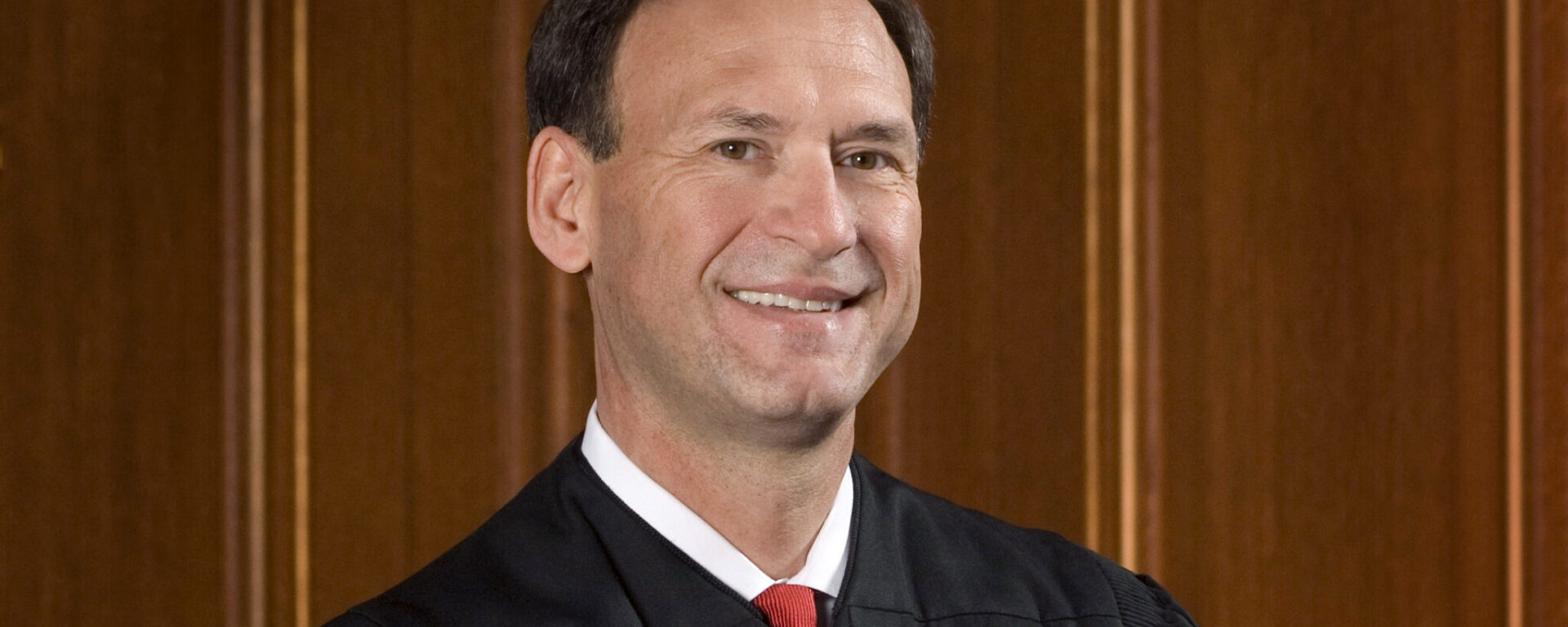

The U.S. Supreme Court issued an emergency stay late on Nov. 21 temporarily allowing a newly redrawn election map that was expected to increase Republican representation in the state’s U.S. House delegation.
The Supreme Court took action hours after Texas appealed a federal district court ruling striking down the election map passed earlier this year.
Justice Samuel Alito, who oversees urgent appeals from Texas, issued an administrative stay halting the lower court ruling. An administrative stay preserves the status quo while giving justices more time to consider a case.
Republicans currently enjoy a razor-thin majority over Democrats in the House of Representatives, and Texas Republicans currently hold 25 of the state’s U.S. House seats. Democrats hold 12 seats. Congressional elections are scheduled for Nov. 3, 2026.
The emergency application that Texas filed earlier in the day asks the nation’s highest court to overturn the ruling and issue an order blocking its enforcement for the time being.
Under the federal Voting Rights Act, the state is allowed to file an appeal directly with the Supreme Court, skipping the U.S. Court of Appeals for the Fifth Circuit.
A three-judge panel of the U.S. District Court for the Western District of Texas held 2–1 on Nov. 18 that the state may not use the new map because “substantial evidence shows that Texas racially gerrymandered the 2025 Map.” The case is known as League of United Latin American Citizens v. Abbott.
In the federal district court’s majority opinion, U.S. District Judge Jeffrey V. Brown said that “the Plaintiff Groups are likely to prove at trial that Texas racially gerrymandered the 2025 Map.”
Gerrymandering refers to the manipulation of electoral district boundaries to benefit a particular party or constituency. The Supreme Court has previously ruled that race-based gerrymandering violates the U.S. Constitution but that redrawing district boundaries to boost partisan fortunes passes constitutional muster.
U.S. District Judge David C. Guaderrama joined the opinion. U.S. Circuit Judge Jerry E. Smith filed a strongly worded dissenting opinion.
Smith described the ruling as the “most blatant exercise of judicial activism” he has ever witnessed.
The majority opinion “has dramatic political consequences by meddling in the orderly processes of a duly-elected state government,” the judge said.
At about midday on Nov. 21, the same three-judge panel voted 2–1 to deny the state’s request to pause the ruling. Again, Smith dissented.
Hours after the Nov. 18 ruling, Texas Gov. Greg Abbott, a Republican, said the claim that the map was discriminatory was “absurd and unsupported” by testimony.
“The Legislature redrew our congressional maps to better reflect Texans’ conservative voting preferences–and for no other reason,” he said.
“This ruling is clearly erroneous and undermines the authority the U.S. Constitution assigns to the Texas Legislature by imposing a different map by judicial edict.”
On Nov. 18, Gloria Leal, general counsel for the League of United Latin American Citizens, praised the panel’s decision.
“State politics cannot and must not interfere with the will of the people of Texas,” Leal said in a statement.
“These judges weighed the legal evidence, studied the intended effects of gerrymandering our state’s voting maps, and reached the conclusion that any reasonable observer would endorse—except those acting out of partisan self-interest.”
In the emergency application Texas filed with the Supreme Court on Nov. 21, Texas Solicitor General William R. Peterson said that this summer, the Texas Legislature “did what legislatures do: politics.”
The Legislature in Austin “redistricted the State’s 38 congressional districts mid-decade to secure five additional Republican seats in the U.S. House of Representatives,” and other states did the same, Peterson said.
“California is working to add more Democratic seats to its congressional delegation to offset the new Texas districts, despite Democrats already controlling 43 out of 52 of California’s congressional seats,” he said. “Virginia Democrats initiated a constitutional amendment for a mid-cycle redraw.”
Peterson said the panel erred when “it failed to follow the strong presumption of legislative good faith, which directs courts to ‘draw the inference that cuts in the legislature’s favor when confronted with evidence that could plausibly support multiple conclusions.’”
It rejected the state’s strong evidence showing good faith, such as the testimony presented by the drawer of the map, who “went district by district,” “sometimes line by line,” providing “political or practical—i.e., non-racial—rationales for his decisions at every step,” he said.
Peterson said the panel aggravated the situation by blocking the map “ten days after Texas’s candidate filing period had already opened.” Invalidating the map had the effect of changing the boundaries of all but one of Texas’s 38 congressional districts and causing “chaos.”
“Campaigning had already begun, candidates had already gathered signatures and filed applications to appear on the ballot under the 2025 map, and early voting for the March 3, 2026, primary was only 91 days away,” Peterson said.
The fact that the panel’s injunction was issued 38 days after the hearing “alone warrants a stay,” he said, citing the Supreme Court’s ruling in Purcell v. Gonzalez (2006).
Purcell held that federal courts ordinarily should not enjoin state election laws close to an election.
Peterson also quoted the Supreme Court’s decision in Republican National Committee v. Democratic National Committee (2020), saying the high court “has repeatedly emphasized that lower federal courts should ordinarily not alter the election rules on the eve of an election.”
Peterson urged the Supreme Court to stay the panel’s decision beyond the temporary administrative stay and agree to formally review the ruling.
Alito directed the League of United Latin American Citizens to respond to the application by 5 p.m. on Nov. 24.
After that, the Supreme Court could act at any time.
Arjun Singh contributed to this report.
Correction: A previous version of this article misstated in one instance the status of Texas’s newly redrawn congressional map after the Supreme Court’s Nov. 21 decision. The Epoch Times regrets the error.
This article by Matthew Vadum appeared Nov. 21, 2025, in The Epoch Times. It was updated Nov. 23, 2025.
Photo: Supreme Court Justice Samuel Alito