

A federal appeals court blocked Michigan’s 2023 ban on counseling for minors that aims to dissuade patients from pursuing a so-called gender transition, declaring it violates the First Amendment rights of therapists.
A three-judge panel of the U.S. Court of Appeals for the Sixth Circuit voted 2-1 on Dec. 17 to issue a preliminary injunction temporarily halting the state law in Catholic Charities v. Whitmer.
This kind of counseling, sometimes called conversion therapy, can encompass “any emotional or physical therapy used to ‘cure’ or ‘repair’ a person’s attraction to the same sex, or their gender identity and expression,” according to WebMD.
Twenty-three states and the District of Columbia ban conversion therapy for minors, according to a report by the Movement Advancement Project.
Circuit Judge Raymond Kethledge wrote in the panel’s majority opinion that Michigan law allows therapists “to offer their minor clients ‘counseling that provides assistance to an individual undergoing a gender transition.'”
If the minor seeks counseling to “change” his “behavior or gender expression” to conform to his biological sex, the therapist can lose his license for providing it.
Violating the law, which took effect in February 2024, can also lead to a fine of up to $250,000.
Michigan’s Department of Licensing and Regulatory Affairs enforces the statute and operates a website that allows anyone to report potential violations, he said.
The judge said the plaintiffs challenging the law provide counseling guided by their Catholic faith that takes the form of “talk therapy,” which consists of “spoken words and nothing more.” They argue that the statute “restricts their speech based on its content and viewpoint, in violation of the First Amendment,” he said.
The judge said a federal district court declined in January to issue a preliminary injunction against the law, finding that the therapy provided by the plaintiffs constitutes conduct that may be regulated, as opposed to speech, which enjoys constitutional protection.
“We disagree and reverse,” he said, adding that the law discriminates based on viewpoint, which means it allows speech “on a particular topic only if the speech expresses a viewpoint that the government itself approves.”
Kethledge said the state’s argument that the law regulates conduct, not speech, “faces strong headwinds as applied to counseling that consists solely of spoken words—spoken words, moreover, that for these plaintiffs reflect the moral beliefs of therapist and client alike.”
Circuit Judge Rachel Bloomekatz dissented.
She described conversion therapy as “a medical practice that developed when homosexuality and gender nonconformity were considered mental disorders, and [that] aims to change an individual’s sexual orientation or gender identity.” Scientific evidence has shown that conversion therapy “is ineffective and harmful,” so Michigan restricted its use, the judge said.
“Not all words receive the same First Amendment protection,” the judge said. “Far from being ‘words and nothing more,’ psychotherapy is an evidence-based medical intervention provided by trained licensed professionals, and it falls within the state’s historic power to regulate medicine.”
The majority opinion “ties states’ hands as to medically-repudiated practices like conversion therapy,” Bloomekatz said.
Luke Goodrich, senior counsel at the Becket Fund for Religious Liberty and lead attorney for the plaintiffs, hailed the new ruling as “a victory for children nationwide.”
“Michigan’s law was pushing children toward irreversible medical procedures that cause lasting harms,” Goodrich said in a statement. “This ruling ensures that children who want it can receive compassionate, evidence-based counseling that alleviates their distress and helps them embrace their bodies without resorting to irreversible, life-altering medical interventions.”
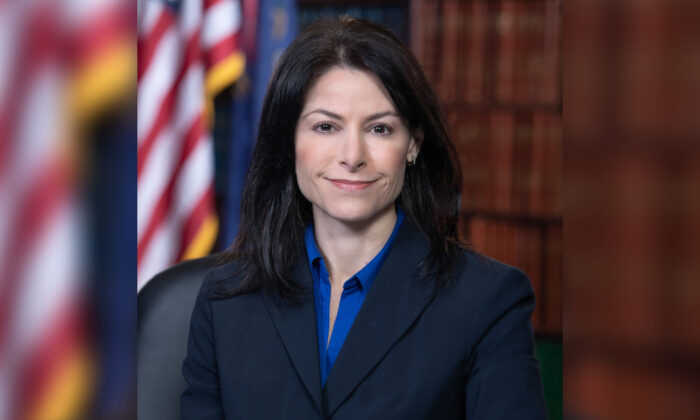
Michigan Attorney General Dana Nessel criticized the ruling, calling conversion therapy “a destructive, demoralizing, and debunked practice that medical experts agree increases the risk of suicide and depression in the young people forced to endure it.”
“If therapists are permitted to harm their clients under the guise of ‘free speech,’ it’s only a matter of time before other licensed professions receive their own carveout,” Nessel said in a statement.
The new ruling was issued as the Supreme Court considers a challenge to Colorado’s law banning conversion therapy.
At an oral argument heard on Oct. 7, several justices seemed sympathetic to a therapist’s challenge to the ban on the ground that it violates her First Amendment right to free speech. Lower courts had ruled that the law regulates a therapist’s conduct, finding that any infringement on her speech was incidental.
The Supreme Court is expected to issue a ruling in the case by the end of June 2026.
Stacy Robinson contributed to this report.
This article by Matthew Vadum appeared Dec. 19, 2025, in The Epoch Times.
Photo: Michigan Attorney General Dana Nessel (D)