

The U.S. Supreme Court temporarily blocked a federal appeals court ruling on Dec. 5 in a lawsuit in which immigration judges are challenging a policy that prevents them from speaking publicly about their jobs.
The issue before the high court is whether the lawsuit should be heard by the courts or by a civil service agency that reviews claims made by federal workers. The Supreme Court has halted for the time being an appeals court ruling directing a lower court to reconsider its dismissal of the lawsuit.
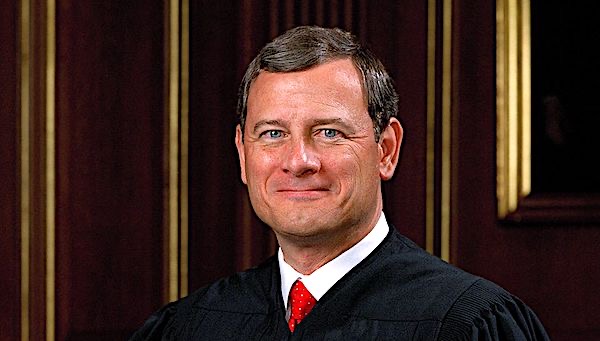
The order in Margolin v. National Association of Immigration Judges was issued by Chief Justice John Roberts and came hours after the federal government filed its emergency application with the Supreme Court.
Roberts issued an administrative stay, which temporarily prevents a ruling against the federal government by the U.S. Court of Appeals for the Fourth Circuit from taking effect as scheduled on Dec. 10. An administrative stay gives the justices more time to consider the application. Roberts did not explain his decision.
The applicant, Daren Margolin, is acting director of the Executive Office for Immigration Review, a sub-agency within the U.S. Department of Justice that conducts deportation proceedings in immigration courts and adjudicates appeals from those rulings.
The respondent, the National Association of Immigration Judges, sued the federal government over its 2021 speaking engagements policy that required immigration judges to obtain a supervisor’s permission to speak at public events. The association claimed that the policy constitutes a prior restraint on its members’ speech in violation of the First Amendment.
In September 2023, the U.S. District Court for the Eastern District of Virginia ruled against the association, holding that the federal Civil Service Reform Act (CSRA) deprives the court of jurisdiction, or authority, over the lawsuit.
The district court dismissed the lawsuit, finding that the dispute must first be adjudicated under the administrative scheme laid down by the federal statute before it can move to the courts. This means that the dispute should be heard by the Merit Systems Protection Board (MSPB) because it pertains to a challenge to a condition of federal employment.
The board describes itself on its website as “an independent, quasi-judicial agency in the Executive branch that serves as the guardian of Federal merit systems.” This means that the board tries to ensure that federal hiring should be based on merit. The MSPB also reviews rules handed down by the Office of Personnel Management, which oversees federal employees.
In June 2025, a three-judge panel of the Fourth Circuit unanimously overturned the district court’s ruling.
The panel remanded the case to the district court after finding that President Donald Trump’s firing of leaders at the MSPB and the Office of Special Counsel had “so undermined” the statute that federal workers could not seek meaningful review in disputes.
The panel directed the district court to develop “a factual record” assessing the “functionality” of the Civil Service Reform Act.
Congress passed the CSRA to deprive district courts of jurisdiction to review legal challenges such as those raised by the association, but the structure of the Act “relies fundamentally … on a strong and independent MSPB and Special Counsel,” according to the panel.
“Serious questions have recently arisen regarding the functioning of both the MSPB and the Special Counsel,” the panel stated.
“We cannot allow our black robes to insulate us from taking notice of items in the public record, including, relevant here, circumstances that may have undermined the functioning of the CSRA’s adjudicatory scheme.”
U.S. Solicitor General D. John Sauer said in the emergency application that the Fourth Circuit had erred.
Sauer said the district court was correct to rule that the CSRA strips the court of jurisdiction and requires that the lawsuit be heard by the MSPB because the respondent is contesting a condition of federal employment.
“This is the rare case where the court of appeals’ decision is so evidently contrary to this Court’s precedents that it calls for summary reversal on two independent grounds,” he stated in the emergency application.
“This Court should stay the court of appeals’ mandate to ensure that developments on remand do not prevent this Court from correcting those manifest errors.”
If the Supreme Court were not to intervene, the appeals court ruling could “wreak havoc” with similar cases, Sauer said.
“Only this court can halt the ongoing and rapidly spreading uncertainty for countless cases,” he stated.
Roberts directed the association to file a reply to the application by 4 p.m. on Dec. 10.
The Department of Justice, which represents Margolin, had “no comment beyond [the Office of Solicitor General’s] filing,” senior media affairs manager Natalie Baldassarre told The Epoch Times.
The National Association of Immigration Judges did not reply to a request for comment by publication time.
This article by Matthew Vadum appeared Dec. 7, 2025, in The Epoch Times. It was updated Dec. 8, 2025.
Photo: Chief Justice John Roberts