
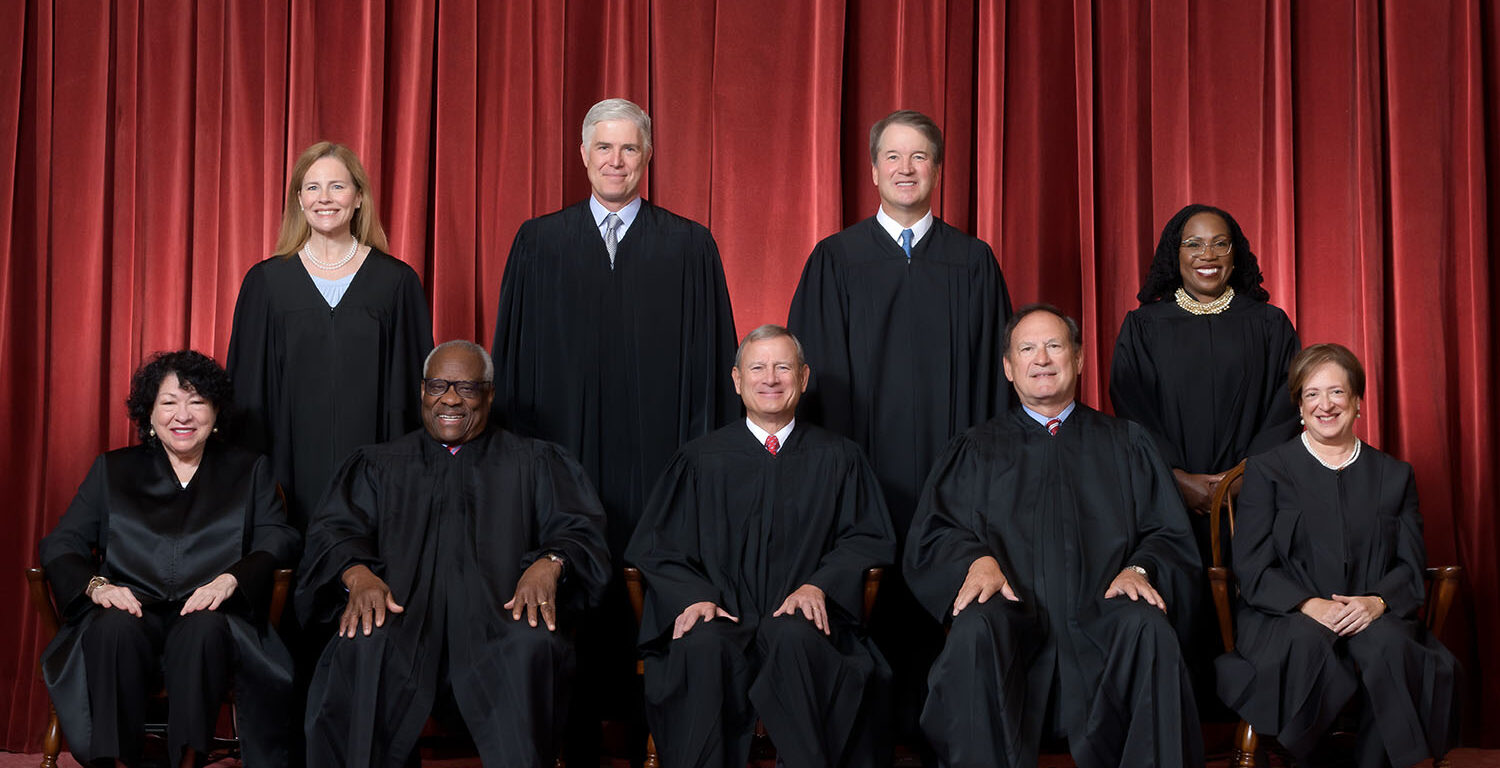

The Supreme Court is likely to strike down federal limits restricting political parties from coordinating spending with candidates, legal experts told The Epoch Times.
Their comments come as the justices prepare to hear a challenge on Dec. 9 to provisions of the Federal Election Campaign Act in the case of National Republican Senatorial Committee (NRSC) v. Federal Election Commission (FEC). The court granted a petition to hear the case on June 30.
The petitioners are the NRSC, the National Republican Congressional Committee, Vice President JD Vance, and former Rep. Steve Chabot (R-Ohio). The respondent is the FEC.
The case pits those who say the First Amendment vigorously protects political speech against those who say the restrictions are needed to prevent corruption and the appearance of corruption in the political process.
In recent decades, the court has struck down campaign finance restrictions on First Amendment grounds.
In Citizens United v. FEC (2010), the court ruled that corporations, nonprofits, and labor unions may spend unlimited amounts on elections, as long as the funds are not provided directly to or used in coordination with a candidate.
In McCutcheon v. FEC (2014), the court invalidated aggregate contribution limits, or the total amount that one donor may give in a specific federal election cycle to all political parties, candidates, and political action committees.
Government regulation may not target “the general gratitude a candidate may feel toward those who support him or his allies, or the political access such support may afford,” Chief Justice John Roberts wrote.
“‘Ingratiation and access … are not corruption,’” Roberts wrote, quoting Citizens United. “They embody a central feature of democracy—that constituents support candidates who share their beliefs and interests, and candidates who are elected can be expected to be responsive to those concerns.”
Normally, the U.S. solicitor general or his designate would appear in court to defend the challenged federal provisions, but the Trump administration has indicated that it believes that the restrictions are unconstitutional and, therefore, will not defend them. In a brief, Solicitor General D. John Sauer said the provisions contain “a campaign-finance restriction that violates core First Amendment rights.”
On July 1, the Supreme Court appointed attorney Roman Martinez to defend the decision by the U.S. Court of Appeals for the Sixth Circuit that upheld the restrictions.
Challengers’ Position
“A political party exists to get its candidates elected. Yet Congress has severely restricted how much parties can spend on their own campaign advertising if done in cooperation with those very candidates,” reads the petition, which was filed in December 2024.
Limits on spending that is coordinated between party committees and candidates were created on the theory that not having such limits encourages corruption and allows wealthy donors to have outsized influence.
Congress enacted the Federal Election Campaign Act in 1972 to limit spending and fundraising in campaigns for federal political office and amended it in 1974 to include limits on how much political party committees may accept and spend to influence a federal election, according to the petition.
A divided Sixth Circuit ruled against the petitioners in September 2024, finding that because the Supreme Court never reversed a landmark 2001 decision known as FEC v. Colorado Republican Federal Campaign Committee, the limits remained constitutional, the petition states.
Although the appeals court determined that coordinated party expenditure limits were inconsistent with recent Supreme Court rulings on the First Amendment, it upheld them, finding that the issue was controlled by the still-binding 2001 precedent, according to the petition.
In the 2001 ruling, the high court held that party-coordinated expenditures, unlike party expenditures given independently of any candidate or campaign, may be limited by law to “minimize circumvention of [individual] contribution limits.”
Those who support the coordination restrictions say they prevent wealthy interests from dominating the political process.
For example, the Campaign Legal Center, which is urging the Supreme Court to uphold the restrictions, says that “for over 50 years these limits on party coordinated spending have served as an important anticorruption tool, ensuring that party committees do not serve as a mechanism for wealthy donors to circumvent individual contribution limits and direct large contributions to candidates.”
Attorneys for the Democratic National Committee (DNC) said in a brief supporting the restrictions that the Constitution does not guarantee to political parties “an unlimited right—unique among political bodies—to subsidize the campaign expenses of federal candidates.”
The Constitution permits Congress to regulate the parties’ “‘coordinated expenditures’ just as it allows Congress to regulate their direct contributions,” according to the DNC.
Lawyers Weigh In
Dan Greenberg, senior legal fellow at the Cato Institute, said political parties exist to help elect slates of candidates.
The Supreme Court has ruled repeatedly that campaigns may be regulated to prevent corruption or the appearance of corruption, Greenberg told The Epoch Times.
“It’s possible for me to imagine bribing a candidate or a public official, but it’s really hard for me to imagine how giving something to a party and that party then having control over its own spending … could then lead to corruption, or the appearance of corruption,” he said.
Greenberg said those who support campaign finance regulations justify restrictions by saying they want to get money out of politics.
“You’re free to try to reduce the amount of money in politics as long as you abide by the Constitution, but once you start interfering with people’s speech rights, you really are interfering with the First Amendment,” he said.
Greenberg said he believes that the court will strike down the challenged provisions because “they are restrictive of free speech … [and] they prevent parties from doing the job that parties are supposed to do, which is to speak to voters about candidates.”
Carrie Severino, president of JCN (formerly the Judicial Crisis Network), said this should be “an easy case for the justices,” who have been “very protective of First Amendment rights,” especially political speech.
“The court has recognized that you can limit speech under certain very limited circumstances, only when it’s going to prevent quid pro quo corruption, when someone would be donating money to a candidate in a corrupt way, basically trying to bribe the candidate,” Severino told The Epoch Times.
A quid pro quo is something given or received in exchange for something else.
In the context of the challenged restrictions, this rationale “makes absolutely no sense,” she said.
“No one in their right mind thinks the National Republican Senatorial Committee is going to attempt to bribe its candidates,” Severino said.
Karen R. Harned, a constitutional law attorney who is affiliated with the Landmark Legal Foundation, said political speech regarding campaigns and candidates is “the First Amendment’s central concern, and government has no business rationing that speech through arbitrary limits on how parties and candidates communicate.”
“The Constitution favors more political speech, not less,” she told The Epoch Times.
“Singling out coordinated communication between parties and their candidates for special restrictions cuts against our tradition of joint First Amendment activity and treats normal party work as suspect.”
Joint First Amendment activity takes place when two or more people exercise their rights to free speech together, often in public places.
By limiting how much a party can spend in consultation with its own candidates, Congress has imposed “layer after layer of limits without concrete evidence of quid pro quo corruption,” Harned said.
“That cannot be reconciled with a First Amendment that bars laws abridging political speech—especially speech at the heart of elections,” Harned said.
This article (an in-depth report) by Matthew Vadum appeared Dec. 8, 2025, in The Epoch Times.