
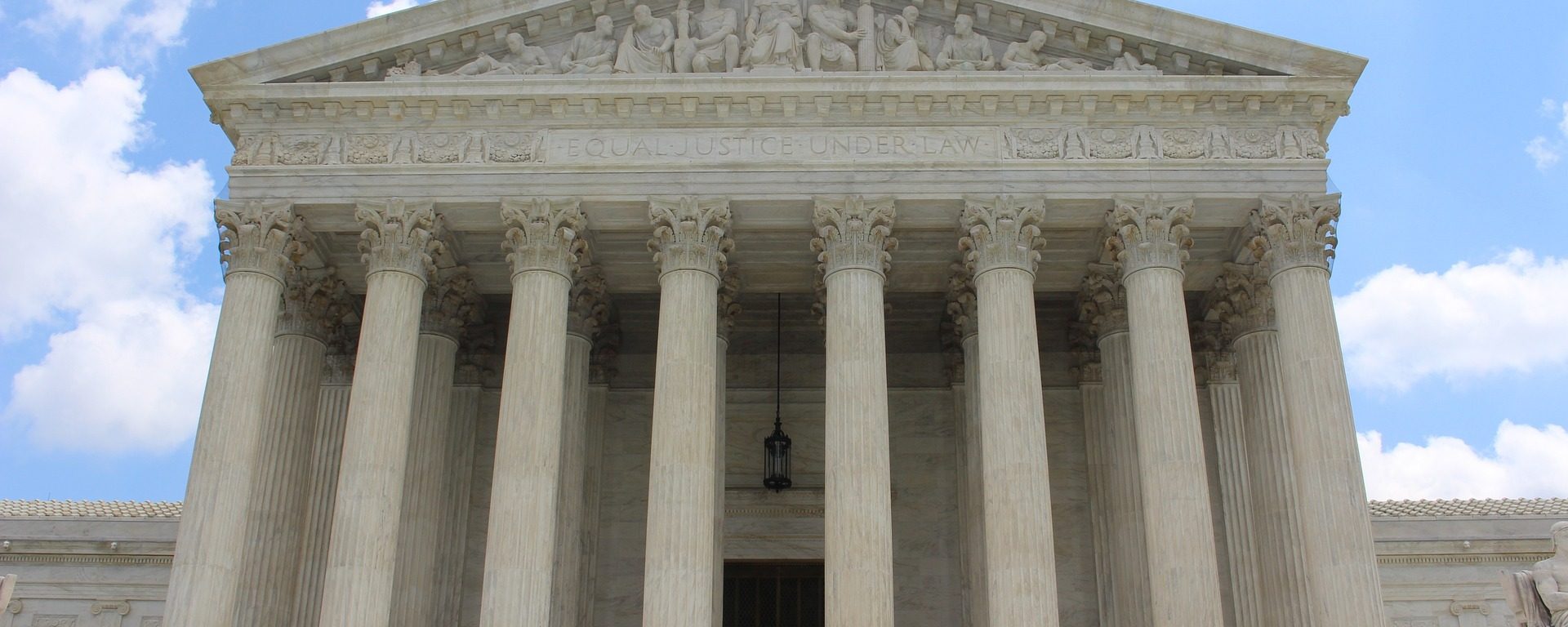

The U.S. Supreme Court declined on March 2 to take up a case dealing with whether art created by artificial intelligence (AI) may be copyrighted under U.S. law.
The justices denied the petition in Thaler v. Perlmutter in an unsigned order. The court did not explain its decision. No justices dissented. The respondent, Shira Perlmutter, is the U.S. Register of Copyrights.
The petitioner, Stephen Thaler, a computer scientist from Missouri, sought a copyright registration in 2018 for “A Recent Entrance to Paradise,” an example of visual art he said his AI system called the Creativity Machine had created. The work depicts train tracks entering a portal, surrounded by what looks like purple and green plants.
The U.S. Copyright Office turned away his application in 2022, holding that copyright may only be granted for creative works that have a human author.
Thaler sued and a federal district court rejected his lawsuit, granting the Copyright Office summary judgment against Thaler.
U.S. District Judge Beryl Howell said the only legal issue before her was “whether a work generated autonomously by a computer falls under the protection of copyright law upon its creation.” The court found that “United States copyright law protects only works of human creation,” according to Thaler’s petition filed with the Supreme Court.
A three-judge panel of the U.S. Court of Appeals for the District of Columbia Circuit affirmed.
“The Creativity Machine cannot be the recognized author of a copyrighted work because the Copyright Act of 1976 requires all eligible work to be authored in the first instance by a human being,” the panel said.
Later, the panel, and then the full circuit court, denied a request to rehear the case.
Thaler’s attorneys argued in the petition that the Copyright Act does not require “any involvement by a natural person” in the work to be registered.
They argued the Supreme Court should take up the case because AI is rapidly developing in the United States and abroad. The Copyright Office’s current policy “is deeply hostile to the use of technology at a time when the United States is seeking to be a world leader in AI,” the petition said.
If the Supreme Court declines the case, even if it decides in another case to overturn the Copyright Office’s human-involvement requirement, “it will be too late,” the petition said.
“The Copyright Office will have irreversibly and negatively impacted AI development and use in the creative industry during critically important years.”
The Trump administration urged the Supreme Court not to take up the case.
U.S. Solicitor General D. John Sauer said in a brief that even though the Copyright Act does not define the term “author,” several provisions in the statute “make clear that the term refers to a human rather than a machine.”
Meanwhile, a case about President Donald Trump’s request to fire Perlmutter as Register of Copyrights remains pending before the Supreme Court.
Trump fired Perlmutter, who heads the Copyright Office, over policy differences in May 2025, after which Perlmutter sued, arguing the termination violated federal law. The U.S. Court of Appeals for the District of Columbia Circuit ruled against the federal government, saying she could remain in her post.
The government filed an emergency application in October 2025 with the Supreme Court to uphold the firing.
The next month, the high court put off ruling on whether Trump may fire Perlmutter until after it rules on the president’s firing of two members of independent agencies.
The Supreme Court could rule on Trump’s firing of Federal Trade Commission member Rebecca Slaughter and Federal Reserve Board member Lisa Cook at any time. The court heard oral arguments in the Slaughter case on Dec. 8, 2025, and on Jan. 21 in the Cook case.
Reuters contributed to this report.
This article by Matthew Vadum appeared March 3, 2026, in The Epoch Times.