
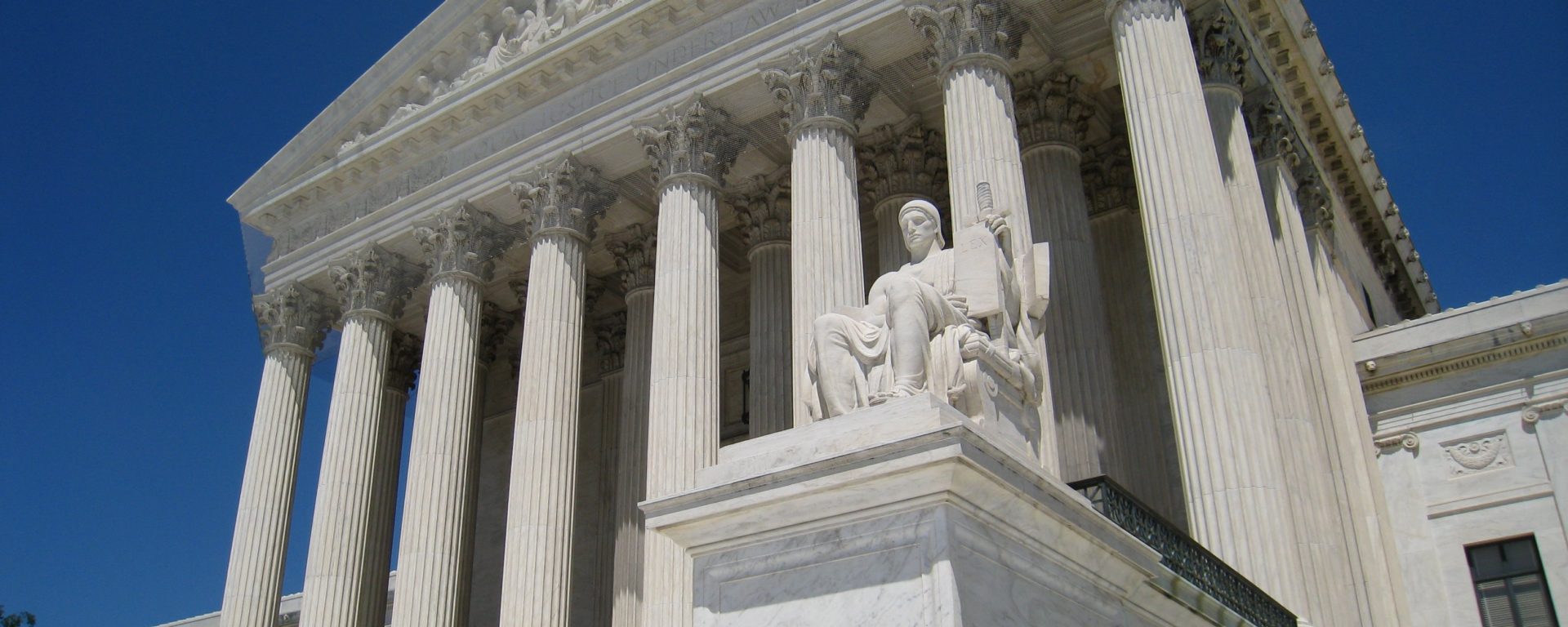

The U.S. Supreme Court scheduled oral argument for April 29 over the Trump administration’s request to end temporary protected status (TPS) for Haitians and Syrians after lower courts blocked the move.
TPS is a designation that allows individuals from countries affected by armed conflict, natural disasters, or other extraordinary events to remain in the United States. Under President Donald Trump, the Department of Homeland Security (DHS) has taken steps to end TPS for about a dozen countries, saying it was always intended to be temporary.
The March 27 scheduling order in Trump v. Miot and Mullin v. Doe, which will be heard together, was posted on the court’s website. Trump v. Miot concerns TPS for Haiti; Mullin v. Doe concerns TPS for Syria.
On March 16, the high court agreed to fast-track the Trump administration’s emergency applications, ordering that they be heard in April, ordinarily the last month the court hears arguments before going on summer recess in late June or early July.
The Department of Justice had asked the Supreme Court on March 11 to allow it to end TPS for Haitians and Syrians after an appeals court blocked the move.
The Obama administration gave the TPS designation to Haiti in 2010 after that country was hit by a devastating earthquake.
Under Trump, DHS found in November 2025 that there were “no extraordinary and temporary conditions” in Haiti that would prevent Haitians from returning to the Caribbean country.
The Obama administration issued the TPS designation for Syria in 2012, citing the Syrian civil war, widespread violence, and deteriorating conditions in that country.
Under Trump, DHS in September 2025 found that with the fall of Bashar al-Assad’s authoritarian regime at the end of 2024 and efforts by the new government to improve conditions in Syria, the status was no longer justified.
U.S. District Judge Ana Reyes ruled on Feb. 2 that the termination of TPS for Haitians was likely motivated, in part, by “racial animus” and issued an order preventing the federal government from ending the Haiti designation.
On March 6, a panel of the U.S. Court of Appeals for the District of Columbia Circuit held 2–1 that DHS had unlawfully terminated the TPS designation for several hundred thousand Haitians residing in the United States and declined to stay Reyes’s order.
U.S. District Judge Katherine Polk Failla blocked the termination of the status for Syria on Nov. 19, 2025.
Failla said DHS had not followed proper procedures for revoking TPS and that its decision was influenced improperly by politics.
DHS had asked the U.S. Court of Appeals for the Second Circuit to stay Failla’s ruling while it appealed, but it declined to do so.
In a March 11 application filed with the Supreme Court, U.S. Solicitor General D. John Sauer said, “Lower courts are again attempting to block major executive-branch policy initiatives in ways that inflict specific harms to the national interest and foreign relations.”
Sauer said that courts around the country have endorsed “a far-fetched and far-reaching equal-protection claim” based on officials’ purported racial animus, and this legal theory now “threatens to invalidate virtually every immigration policy of the current administration.”
Haitian TPS holder Fritz Emmanuel Lesly Miot had urged the Supreme Court to leave the D.C. Circuit’s ruling in place.
“Deportation to Haiti would place TPS holders in mortal danger,” Miot’s attorneys said in a brief filed March 16.
The brief stated that terrorist and gang violence has nearly paralyzed Haiti, which also suffers from “famine-like conditions.” It states that reports indicate the threat of violence has shut down essential services, including roadways and hospitals, and that “the humanitarian situation in Haiti is considered among the most dire in the world.”
Haitian TPS holders have resided in the United States for almost two decades “without problem,” and “there is no sudden emergency requiring their immediate expulsion,” the brief stated.
Syrian TPS holder Dahlia Doe has asked the high court not to take up the federal government’s application.
The district court “correctly concluded that the [DHS] Secretary’s decisions were based on a predetermined plan to end TPS for every country—which is precisely what the Secretary has done to date,” Doe’s lawyers said in a brief filed March 5.
This article by Matthew Vadum appeared March 27, 2026, in The Epoch Times.