
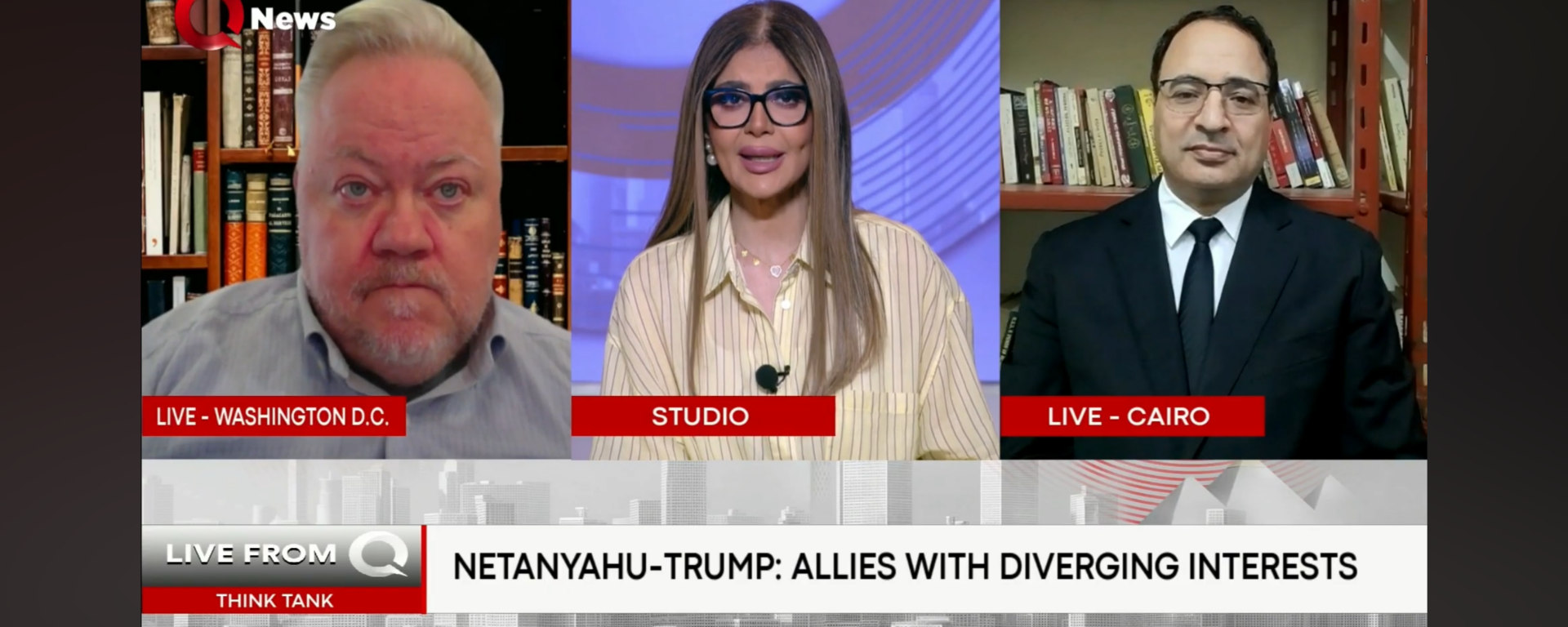

On July 27, 2026, Matthew Vadum joined host Rana Elkassas on QNews in Egypt for its Think Tank program for a discussion of the relationship between President Donald Trump and Israeli Prime Minister Benjamin Netanyahu. The segment examined the two leaders’ upcoming White House meeting amid clear differences over strategy toward Iran.
Netanyahu was traveling to Washington for what would be his eighth meeting with Trump this term. Iran is expected to top the agenda, alongside Lebanon, Gaza, and broader regional issues. Reporting, including from The New York Times, had highlighted a growing gap: Trump is drawn toward a negotiated path focused on reopening the Strait of Hormuz, while Netanyahu continues to press for sustained pressure aimed at eliminating the residual nuclear and missile threat.
Vadum told the host the divergence is real and strategic, not merely a matter of Trump being tired of the conflict.
“I think that it is a gap in strategy,” he said. “Israel views the nuclear threat posed by Iran as an existential matter, a threat to the very existence of the Jewish state and wants it dealt with once and for all. Now Trump wants the nuclear nonproliferation issue also dealt with decisively, but right now that is not his highest priority. His highest priority is reopening the Strait of Hormuz because he is feeling political pain as a result of rising gasoline prices, which make voters angry at the party in power and seek to punish them in the next election, which is in the off-year congressional elections in November.”
The host pressed on public opinion and whether Trump had already lost support. Vadum noted that Republicans largely remain behind both the president and the Iran campaign, but independents and Democrats are not.
“It’s very difficult to win an election in the United States without having independent voters on your side,” he said. “And right now independent voters are turned off by Donald Trump and by the war in Iran. Trump was elected on a promise of no new wars. And so people, some people are trying to hold him to that promise.”
He added that many Americans do not view Iran as an imminent threat to the United States itself. “I believe Iran is a genuine threat. But my view is a minority one among members of the public. They’re not convinced that Iran posed an imminent threat to the United States. And so it’s difficult to get them to go along with the idea that the United States should be launching bombing runs and air strikes against Iran.”
The conversation also turned to Trump’s reported private criticism of Netanyahu, including calling him “crazy” and asserting that the Israeli leader would ultimately do what Trump wants. Vadum described this as classic Trump style rather than evidence of a fundamental rupture.
“President Trump is a fairly vulgar individual,” he said. “And I think that that is part of his charm for a lot of voters–that he’s a real guy and he speaks like a normal person. … The fact that he has criticized Netanyahu in public and said nasty things about him doesn’t change the fact that the United States and Israel are still close allies. But I think it reflects the fact that Trump hasn’t been able to play Netanyahu like a puppet on a string. He’s not a marionette for the United States and Netanyahu doesn’t do everything that Trump tells him to do.”
On the domestic politics of Netanyahu’s visit, Vadum observed that the Israeli leader is trailing in the polls ahead of Israel’s fall election. The trip serves dual purposes: policy coordination and political optics.
“I think Netanyahu is visiting the United States to accomplish both things,” he said. “I think he wishes the optics for domestic Israeli political consumption to show that he’s still close to President Trump and that Israel and America are still close allies. And I think he’s also trying to talk to Trump and trying to get him to recommit to his objective of emphasizing non-nuclear proliferation by Iran.”
The full discussion is available here: