
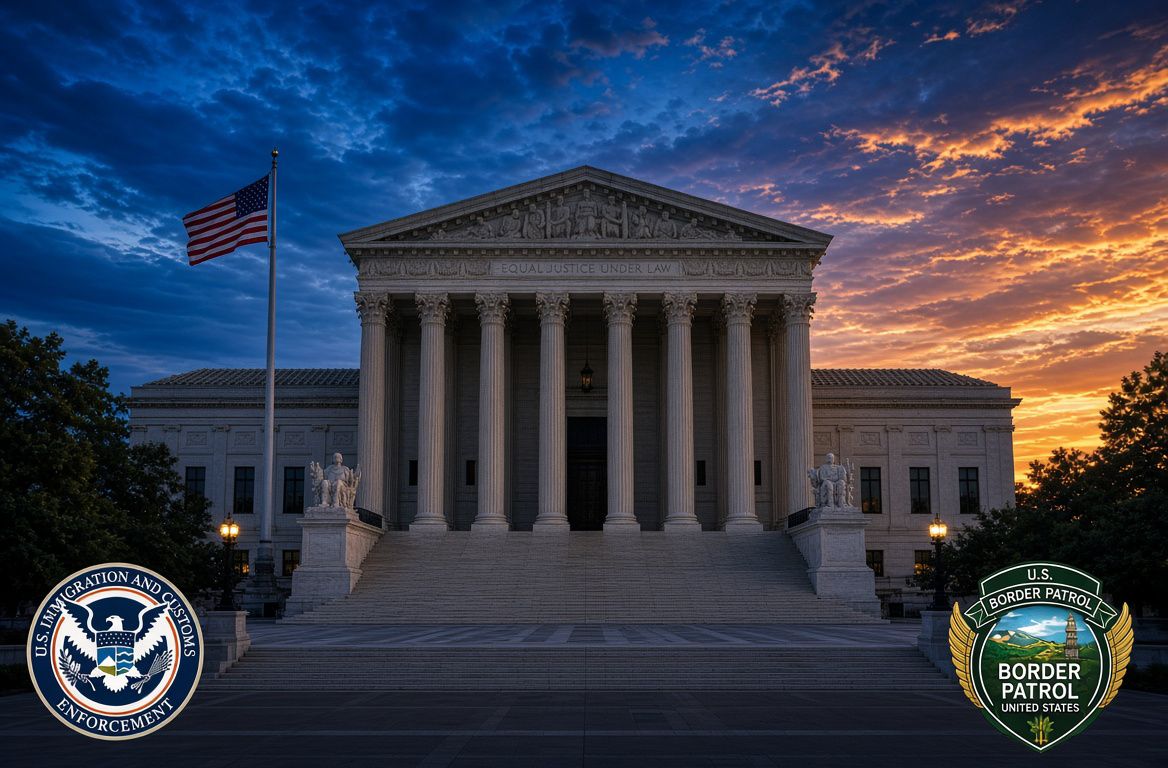

The Trump administration asked the Supreme Court to reinstate a blocked border policy, arguing that judges were wrong to limit the president’s power to stop illegal crossings and cut off asylum claims.
In a petition filed with the nation’s highest court on Aug. 24, the Department of Homeland Security asks the justices to review a ruling by the U.S. Court of Appeals for the District of Columbia Circuit that invalidated part of President Donald Trump’s Proclamation 10888.
That document, “Guaranteeing the States Protection Against Invasion,” suspended entry for individuals crossing the southern border illegally and largely barred them from seeking asylum.
The proclamation invokes the federal government’s responsibility under Article IV, Section 4 of the U.S. Constitution, which requires the government to “protect each of [the States] against Invasion.” Trump formally declared in the document that “an invasion is ongoing at the southern border,” so the government was required to act.
The proclamation is based on “a commonsense understanding of the President’s inherent and delegated powers to exclude aliens,” according to the petition.
Guidance issued by DHS to implement the proclamation said that people who crossed the border illegally could be immediately repatriated and would generally not have access to the asylum process. The guidance did not apply to unaccompanied children or refugee claimants who fear torture if returned to their home countries.
A federal district court ruled for the plaintiffs, finding that provisions in the proclamation and guidance that blocked access to asylum procedures and the normal deportation process were unlawful. The court entered an injunction blocking the provisions.
A divided D.C. Circuit affirmed, holding that the president’s power to suspend entry does not allow him to create a summary removal process that bypasses the system provided in the Immigration and Nationality Act or a broad power to deny the right to apply for asylum. The court later denied a rehearing of the case before all its members.
The Trump administration argues it had clear authority under the Immigration and Nationality Act to suspend entry and that the lower courts misread the statute.
U.S. Solicitor General D. John Sauer argues in the petition that the D.C. Circuit’s ruling “threatens to dismantle” the proclamation, which Homeland Security Secretary Markwayne Mullin has called “an ‘indispensable’ tool for controlling the border.”
Since the proclamation took effect, “border encounters have fallen by 93 percent, dropping to the lowest levels since the 1960s,” the petition states. The curbs on asylum claims in particular “have been critical to maintaining the effectiveness of the Proclamation,” it said.
Sauer argues the D.C. Circuit erred in requiring the government to accept asylum claims from those who entered the country illegally, which the government considered to be “futile” because it has said it will not grant them.
“The court of appeals’ insistence that aliens are entitled to file futile asylum applications elevates empty procedures over substance,” he said.
The circuit court was also wrong to reject the power the president claims to possess to suspend entry at the border, and to certify the plaintiffs—some of whom have not suffered an injury—as a class for the purposes of a class action, he added.
The high court directed the lead respondent, a group called the Refugee and Immigrant Center for Education and Legal Services, to respond to the petition by Sept. 23.
This article by Matthew Vadum appeared Aug. 25, 2026, in The Epoch Times.