
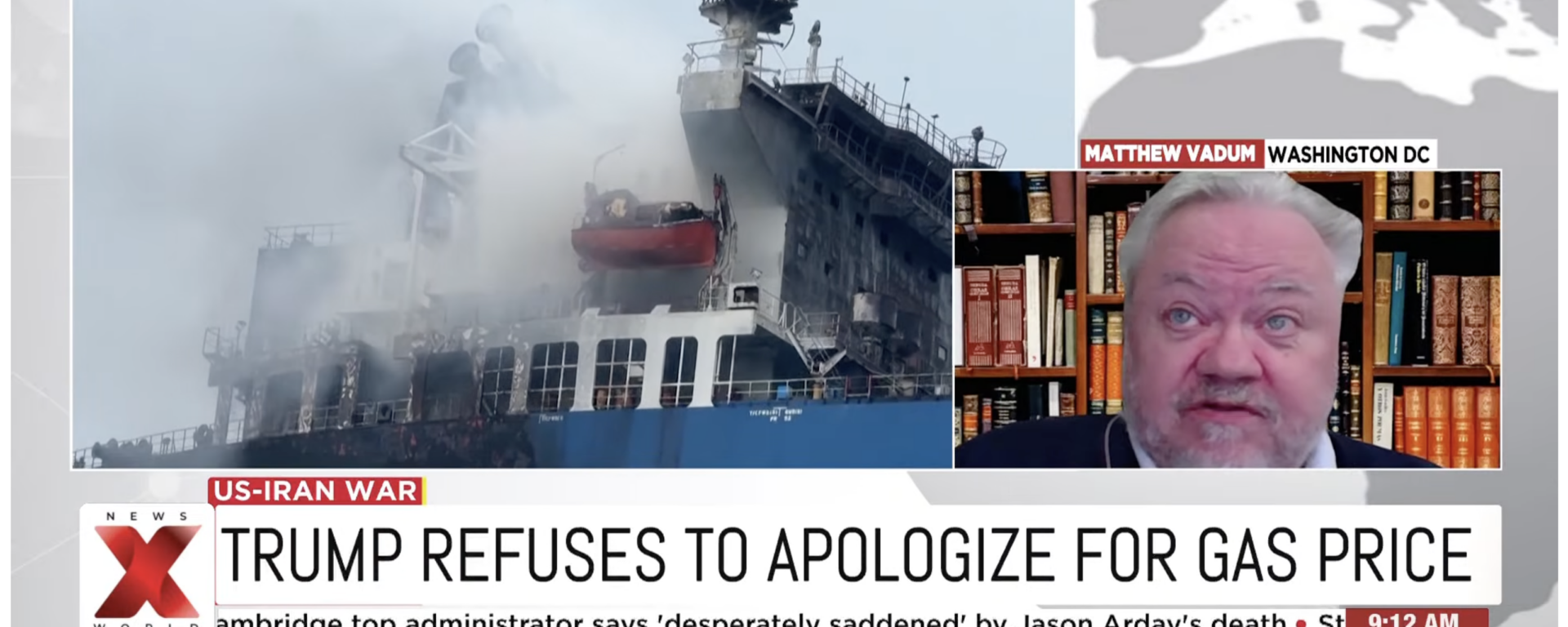

Investigative journalist and author Matthew Vadum appeared on NewsX World in India on August 14, 2026 (August 15 in India) to discuss President Donald Trump’s recent comments on elevated gasoline prices and the escalating threat posed by Yemen’s Houthi rebels to the strategic Bab al-Mandeb Strait. The anchor was Keren Nanyaro.
The full segment is available here:
In the appearance, Vadum addressed Trump’s remarks from a New York rally in which the president described higher gas prices—currently averaging around $4 per gallon—as “okay” and declared he would “never apologize” for them, framing the increase as the necessary cost of preventing Iran from obtaining a nuclear weapon.
Vadum supported the underlying strategic objective while criticizing the public messaging. “Trump is being straightforward about the trade-off,” he said. “Higher prices are the cost of confronting Iran. That’s a legitimate argument. The problem is the delivery. Telling people ‘it’s okay’ and ‘I’ll never apologize’ while they’re paying around four dollars a gallon comes across as callous.”
He noted the inconsistency with other administration statements, including Vice President JD Vance’s recent description of keeping oil and gas cheap as “goal number one.” Vadum argued that policymakers can defend the Iran campaign without appearing indifferent to the real financial pressure on American households.
Turning to the Red Sea, Vadum backed Yemen’s foreign minister-designate, who warned that the Iran-backed Houthis must not be allowed to hold the Bab al-Mandeb Strait hostage. The Houthis have declared a maritime blockade targeting Saudi shipping and have carried out attacks that raise costs and risks for vessels using the critical chokepoint linking the Red Sea to the Gulf of Aden.
“Yemen’s foreign minister is right,” Vadum said. “The Houthis cannot be allowed to hold the Bab al-Mandeb Strait hostage. They’re trying to copy Iran’s Hormuz playbook—using a second vital waterway for leverage. With Hormuz already disrupted, threatening the Red Sea route creates another major pressure point on global trade and energy.”
He criticized the international response to date as insufficient and warned that permitting an Iranian proxy to weaponize another key shipping lane would impose lasting costs on commercial navigation and energy markets worldwide.
Vadum connected the two issues by observing that Iran and its proxies continue to impose economic pain through military pressure on maritime chokepoints. Clear explanations of those trade-offs, he suggested, serve the public better than either denial of the costs or indifference to them.