
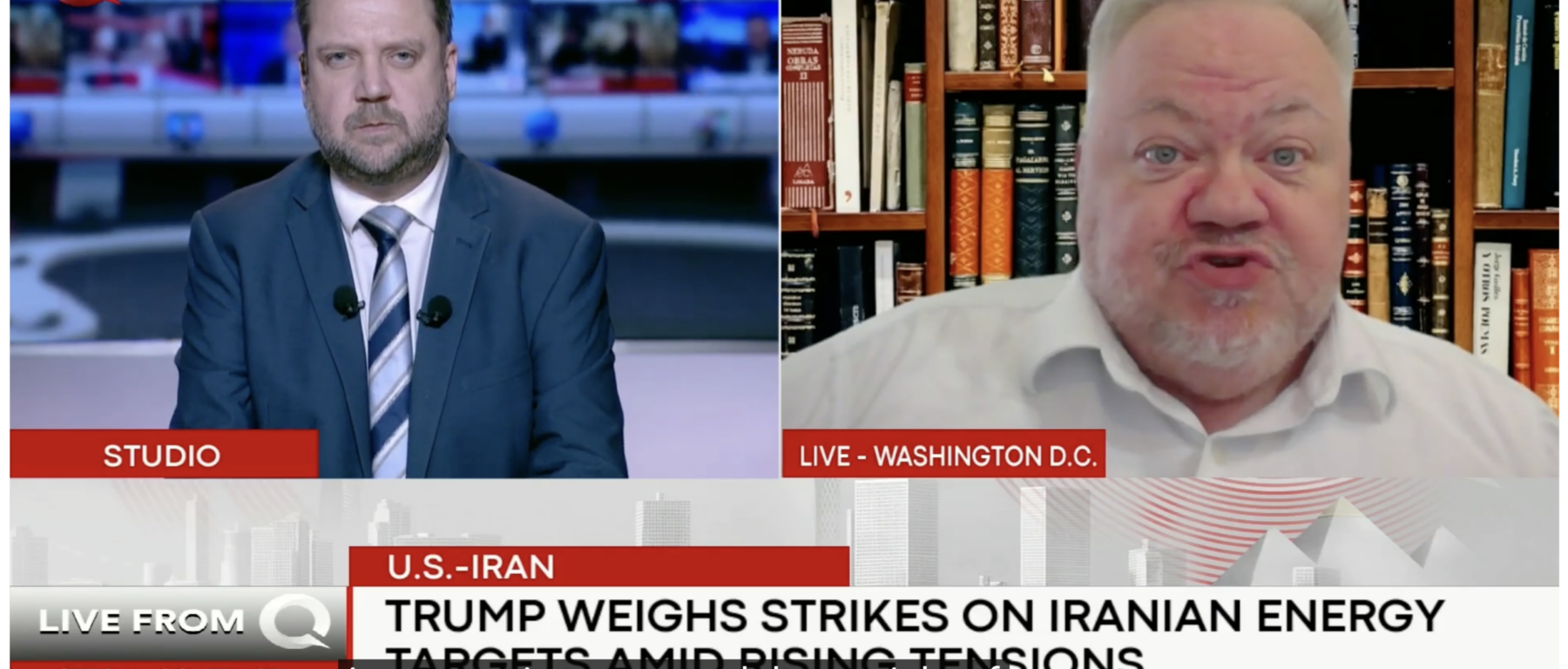

Investigative journalist Matthew Vadum appeared on three international television programs on August 1, 2026, discussing U.S.-Iran tensions centered on the Strait of Hormuz and energy infrastructure threats, as well as Egyptian-mediated efforts to implement a Gaza agreement.
The appearances came amid reports of Iranian claims of tanker attacks in the Strait of Hormuz, drone interceptions, fresh warnings from Iranian officials of retaliation against U.S. and Israeli energy and critical infrastructure if the United States or Israel struck Iranian energy sites, and President Donald Trump’s reiterated threats of further military action. Parallel discussions focused on a reported U.S.-Israel understanding for phased Israeli withdrawal from Gaza in exchange for Hamas disarmament, coordinated with Egyptian and other mediators. These appearances continued Vadum’s frequent commentary on the Iran conflict, U.S. strategy under Trump, the interplay of military pressure and domestic political constraints, and related regional diplomacy.
QNews (Egypt)
Vadum joined QNews, anchored by Mark Somers, for a segment titled “Will Iran retaliate if Trump targets its energy sites?” The discussion addressed the risk of Iranian retaliation should the United States expand operations against Iranian energy infrastructure, amid ongoing disruptions in the Strait of Hormuz, Iranian Revolutionary Guard claims of targeting tankers, and mutual accusations of escalating the conflict.
Consistent with his prior analysis, the exchange examined whether Iranian threats of extensive response plans targeting U.S.-linked energy assets and Israeli infrastructure were credible, the potential for wider regional involvement, the choke-point role of the Strait (through which roughly 20 percent of global oil normally passes), and the domestic political pressure on the Trump administration from elevated oil and gasoline prices ahead of the November midterm elections. (Note: On the show, Vadum inadvertently misdescribed Trump’s statement, saying the president supported the charges being dropped against an Olympian accused of vandalizing the Reflecting Pool; in fact, Trump was upset that the charges were dropped by prosecutors.)
Video clip:
AlQahera News (Egypt)
Vadum appeared remotely from Washington on AlQahera News’ “Midday” program (منتصف النهار), anchored by Hajar Jalal. (The episode was conducted in Arabic.) The primary focus was Egyptian diplomatic efforts, coordinated with the United States, Qatar, Turkey and other mediators, to advance the second phase of a Gaza agreement following Trump’s announcement of a U.S.-Israel understanding. That understanding envisioned phased Israeli withdrawal from Gaza in exchange for Hamas disarmament, linked in some reporting to diminished Iranian influence. A Peace Council roadmap outlined a 14-day timetable for a National Committee to administer Gaza, parallel disarmament and cessation of operations, reconstruction, empowerment of the Palestinian Authority, and a political path toward a Palestinian state. Israeli sources expressed reservations, insisting on verified, complete Hamas disarmament before significant withdrawal.
Other participants included Abdel Fattah Dawla (Fatah spokesterrorist), who stressed Egypt’s central role in relieving suffering in Gaza and the need for U.S. pressure on Israeli Prime Minister Benjamin Netanyahu, and Dr. Ahmed Fouad Anwar (Israeli affairs expert based in Cairo).
Vadum expressed skepticism about full implementation. He questioned whether Israel would show genuine enthusiasm for withdrawal given hardline elements in Netanyahu’s government and Israel’s view of Hamas as an enduring enemy, and whether Hamas would comprehensively disarm production sites and tunnels. He described the U.S. position under Trump as sincere but noted the absence of ironclad guarantees that Israel would adhere. He rejected characterizations of Israeli military operations as genocide, calling such claims fabricated, while acknowledging collateral damage inherent in urban warfare. On reconstruction, he observed that involvement by an international Peace Council (including Egypt) remained unclear in its practical mechanisms.
Video clip:
NewsX World (India)
Vadum joined NewsX World from Washington, D.C., primarily addressing rising West Asia tensions under the title “Iran Warns United States as Strait of Hormuz Tensions Spiral Across West Asia.” The segment covered Iranian accusations that the United States was escalating the conflict, Revolutionary Guard claims of additional tanker strikes in the Strait of Hormuz, Kuwaiti drone interceptions, Trump’s demands that Iran reopen the waterway and comply with the collapsed truce, and Iranian warnings against neighboring countries supporting U.S. operations. Reports of possible U.S.-Israeli strikes on Iranian infrastructure (including energy facilities) and Iranian vows of retaliation formed key context.
Vadum assessed that the situation was more likely to deteriorate than improve. He cited mutual grievances (U.S. views of Iranian breaches of the memorandum of understanding versus Iranian resentment of continued pressure) and warned that miscalculation could widen the conflict, with intensified American strikes prompting Iranian asymmetric responses such as targeting U.S. military installations in Gulf states like Bahrain and Saudi Arabia. He noted Iran’s preference for drones, missiles, and other asymmetric tactics. Diplomatic channels (via Pakistan, Saudi Arabia, or the international Board of Peace) existed but were constrained by Iran’s nuclear program. On the Strait of Hormuz, he emphasized its role as a critical choke point (roughly 20% of global oil) and outlined U.S. options including sustained sanctions, further degradation of Iranian missile capabilities, and more aggressive action against Iran’s fast-attack “mosquito fleet.”
The appearance also covered domestic U.S. political developments involving acting Attorney General Todd Blanche. Discussion addressed the stalled Senate confirmation process for Blanche (Trump’s former personal lawyer elevated to the acting role), Republican resistance from senators such as John Cornyn and Tom Tillis over the status of the roughly $1.8 billion “anti-weaponization” fund tied to an IRS settlement, Blanche’s prior testimony that the fund was dead, and Trump’s more recent statements signaling willingness to keep Blanche in the acting role while potentially reviving or defending the fund. Vadum addressed the political dynamics of the confirmation fight, the tension between White House priorities and Senate GOP skeptics, and the broader implications for the U.S. Justice Department.
The anchor was Ellie Richardson.
Video clip:
NewsX World, again
In the evening of August 1 (August 2 in India), Vadum returned to NewsX World for additional segments covering developments in the Iran conflict and a mass shooting in Idaho.
On the Iran front, the discussion centered on President Trump’s announcement that he had called off a massive imminent U.S. military strike against Iran. Trump stated the United States had been “locked and loaded” at military power levels not seen since World War II, but canceled the attack after Tehran and other Middle Eastern nations requested a hold, citing agreement on a framework for a major deal. The prospective agreement, according to Trump, included the immediate and total opening of the Strait of Hormuz and a permanent end to Iran’s nuclear threat, with Israel fully aligned (subject to finalizing the deal). Trump also commented on the collapse of Iran’s currency and economy, claiming the country was facing severe inflation and that administration efforts were actively targeting its currency stability as part of broader maximum-pressure strategies, including sanctions and oil export restrictions. Anchor Ruby Barlow introduced Vadum for analysis of these developments, including the credibility of the framework, comparisons to prior understandings such as the earlier memorandum of understanding, the economic pressure campaign, and the prospects for rapid negotiations amid ongoing mutual threats and regional tensions.
Separately, Vadum addressed the mass shooting at an In-N-Out restaurant in Twin Falls, Idaho. A gunman opened fire inside and outside the restaurant along Blue Lakes Boulevard North just before 2:30 p.m. local time on August 1, creating chaos among customers and shoppers. Twin Falls Police Chief Matthew Hicks confirmed multiple fatalities (initial reports indicated at least three dead, including the suspected gunman, and others injured; figures were still being verified), with the shooter among the dead and no ongoing threat to the community. The FBI and Idaho State Police assisted the investigation; the shooter’s identity and motive had not been released. Vadum observed that Idaho was an unusual location for such an incident and that the use of an AR-15 (which is often described by some as an assault rifle) to attack people raised the possibility of terrorism, though authorities had not yet labeled it as such and were awaiting more evidence. He noted the absence of any reported manifesto, ideological claims, or foreign terrorist connections at that early stage (the attack had occurred only about nine hours earlier) and said more details would likely emerge in the following 24 hours as the investigation progressed.
Videos: