
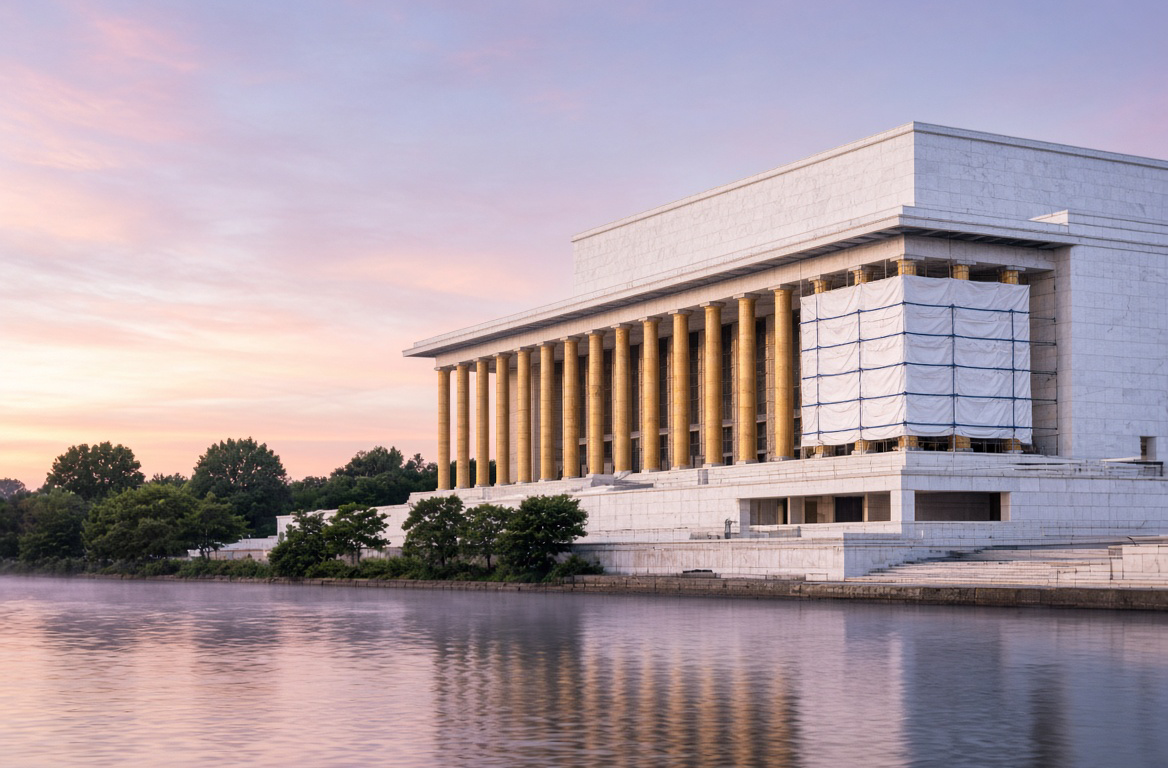

A federal judge on Sept. 15 blocked the Kennedy Center’s board from putting President Donald Trump’s name on the building’s facade or renaming its grounds in his honor.
Hours later, the board voted to close the arts facility “immediately” for safety reasons so rehabilitation work could be performed on the building, Trump said in a Truth Social post. Soon after, the federal government appealed the judge’s ruling to a higher court.
In his order, Judge Christopher R. Cooper ruled that the rehabilitation plan would violate his prior injunction, as well as the 1964 law that made the cultural center a memorial to the late President John F. Kennedy.
The judge said that in 1983, Congress amended the 1964 law to ensure that “no additional memorials or plaques in the nature of memorials shall be designated or installed in the public areas of the John F. Kennedy Center for the Performing Arts.”
“Simply put, Defendants cannot install memorials for President Trump or anyone or anything else at the Kennedy Center without Congress’s blessing,” he said.
On Aug. 13, the Trump-appointed board voted to add an inscription under the Kennedy name—“Restored and Renovated by President Donald J. Trump”—and to proceed with a closure for renovations.
Because that board resolution “bucks a federal court order and a statute Congress enacted,” plaintiff Rep. Joyce Beatty (D-Ohio), an ex officio member of the board who sued over the name change, is “entitled to enforcement of the Court’s injunction, which reflects Congress’s decision to memorialize President Kennedy, and no one else, at the Center bearing his name,” the judge said.
On May 29, Cooper ordered that Trump’s name be struck from the John F. Kennedy Center for the Performing Arts and blocked officials from a two-year shuttering the venue for renovations. Crews removed the letters in June.
The new block came in response to a motion filed by Beatty’s attorneys.
In court papers filed Sept. 14, Beatty said that the board was considering two draft resolutions: one to close the main building over safety concerns, and the other to inscribe Trump’s name on the facade in exchange for his millions in fundraising assistance.
Beatty’s notice, filed with the court, said the claim that the building poses public hazards “incorrectly asserts that the Delta Consulting Group considers the main building ‘unsafe for continued occupancy,’ when Delta expressly disclaimed providing any such opinion.”
Cooper has not blocked the renovations themselves and said in his Sept. 15 ruling that the board may access the $257 million Congress appropriated for needed capital improvements. He said Commerce Secretary Howard Lutnick had told the board at their Aug. 13 meeting that Trump was prepared to use the funds to complete the rehabilitation project.
Lutnick on Sept. 15 shared footage of plaster dropping 60 feet from the ceiling of the Kennedy Center from water damage after a Sept. 4 storm.
“Failing roofing, collapsing concrete supports, and steel that is rotting have created completely unsafe conditions,” he said on X. “The entire building is in this kind of shape. People cannot be allowed to go into this building any longer.”
The government has not shown that “current or future donations hinge on President Trump’s name being on the building,” the judge said. He also rejected claims that removing the Trump name “would prevent the Center from fulfilling its artistic mission, as it has done for the last 60 years.”
The renaming of the center “coincided with declines in revenue and contributions, as artists cancelled performances, the Washington National Opera ended its 50-year residency, and ticket sales and viewership of the Kennedy Center Honors broadcast dropped precipitously,” Cooper said.
It is unclear when the U.S. Court of Appeals for the District of Columbia Circuit will take up the government’s appeal of Cooper’s new order. An appeal of the judge’s prior injunction is also pending at the same court.
This article by Matthew Vadum appeared Sept. 15, 2026, in The Epoch Times.