

Midterms, Iran, and a $5,000 Check
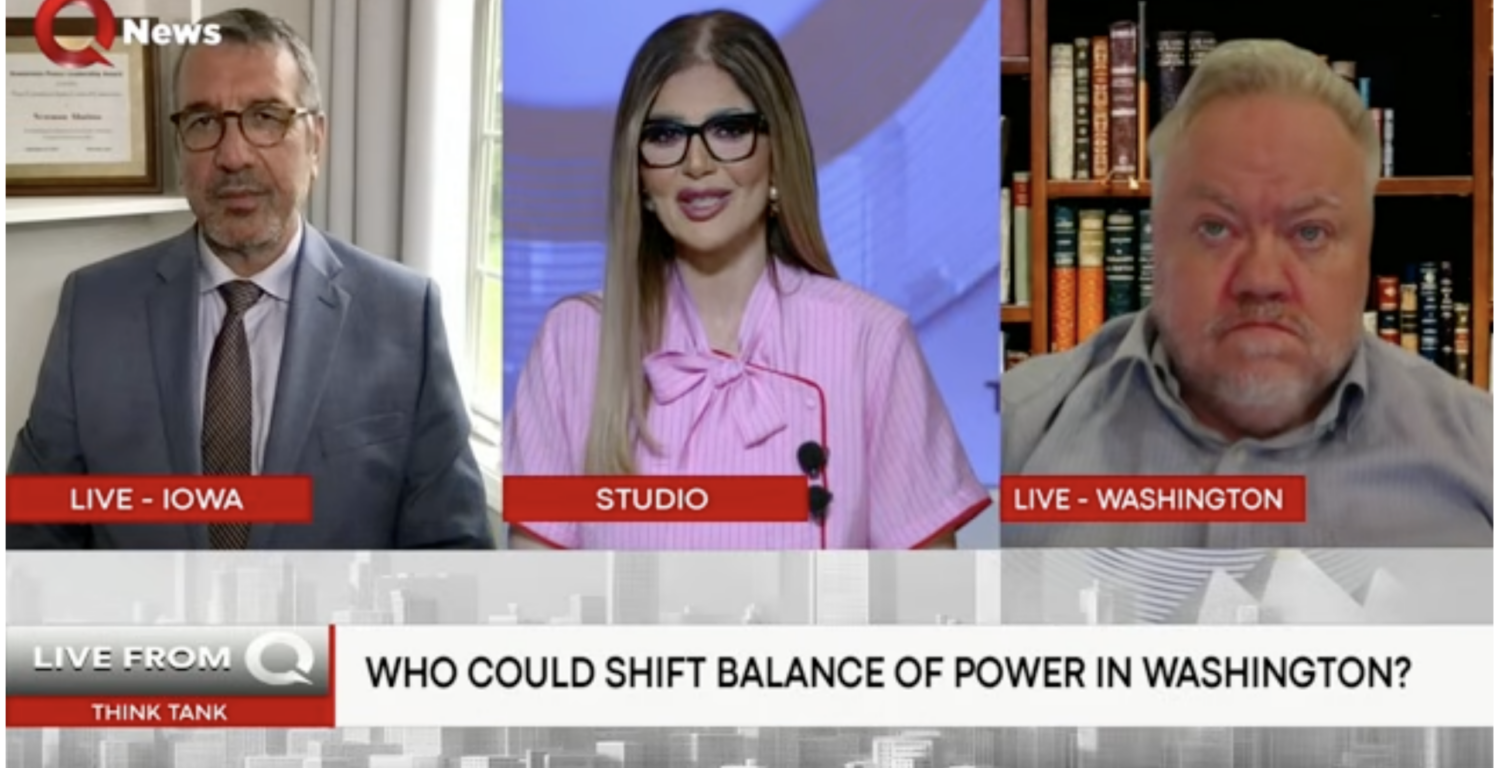
Investigative journalist and author Matthew Vadum appeared September 17, 2026, on Egpyt’s QNews for a “Think Tank” segment titled “Washington’s balance of power faces midterms test.”
Anchor Rana Elkassas hosted. The other guest was Iowa-based political analyst Newman Abuissa.
The panel treated the November 3 midterms as a referendum on President Trump: inflation, gasoline, the unfinished Iran war, and whether Republicans can hold the House. A Trump clip on a $5,000 “dividend” to adult citizens ran in the show.
Vadum said a midterm is “always a referendum on the president and his party,” and that the party in the White House tends to lose seats. “I think that the Democrats are on track to recapture the House of Representatives. The Senate, they might capture too, but that picture is less certain.”
Michigan was the caveat. He pointed to “controversial candidates like El-Sayed in Michigan who scares a lot of voters,” then roughly tied in polls with Republican Mike Rogers. “It is not at all clear that the Democrats are going to hang on to that seat. So that could be a flip for Republicans.” When Abuissa objected that Abdul El-Sayed was not dangerous, only different, Elkassas asked Vadum why he thought El-Sayed was dangerous. Vadum’s answer: “because he’s an Islamist and because he’s far-left.”
He tied Republican prospects to Trump’s standing. “These midterm races are generally driven by the president’s popularity or his lack of popularity… President Trump is not popular. His war in Iran is not popular.” Trump, he said, keeps announcing the war is over or about to be over, “but he’s been saying that since a few weeks after he started it on February the 28th.”
On Iran and style: Trump’s “perceived lack of backbone on the Iran war has caused the war to drag on.” His “obsession with negotiation” treats Tehran like a game of Let’s Make a Deal. “He seems to think he’s Monty Hall, and he wants to make a deal with the Iranians who have no interest in making a deal.” They want the fight to last past November 3, Vadum said, “because they think that that will make Trump less popular and give the Democrats who take a much softer line on Iran a chance to control the Congress.”
On the $5,000 check: “Presidents promising to bribe voters with their own money is the American way… this $5,000 Trump dividend is a more flagrant example of it.” The pro-Trump Super PAC MAGA Inc. had been sitting on about $400 million; it had already spent $10 million for Ken Paxton’s Senate campaign in Texas and reserved about $140 million in TV ads.
“Donald Trump’s problems here are largely of his own making. He has an inability to stay on message. He blurts out whatever pops into his head with not much of a filter… he keeps promising things that are impossible.” If Democrats take the House, “they’re going to impeach Donald Trump again and again… he may be a lame duck for the final two years of his presidency.”
An October surprise is possible. As of this taping, “it looks like Democrats have the upper hand.”
Watch:
Escalating Middle East Fronts
Vadum appeared on September 15, 2026, on Al Qahera News (sister network of QNews) during a special segment titled “The Middle East Faces an Escalating Scene… Multiple Fronts Continue to Impose Themselves on the Region.”
The show was conducted in Arabic.
The discussion centered on the region’s interlocking crises: U.S.-Iran clashes in the Strait of Hormuz, Houthi attacks on Saudi infrastructure and advances toward the Bab el-Mandeb, postponed Iran-Gulf talks on the waterway, and the risk that pressure on one front quickly reopens others in Yemen, Lebanon, and the Gulf.
Vadum analyzed the situation from Washington. He stressed that the fronts are not separate matters but one connected conflict, where Iran uses proxies to keep multiple pressure points active at once. He also highlighted how mixed signals from Washington and Tehran’s stalling tactics prolong the disruption, especially to global energy flows, and warned that declaring the strait open does not match the reality on the water.
Watch the segment:
Trump wants to keep Iran’s oil
Vadum appeared on September 14, 2026, on QNews. He read Trump’s talk of staying in Iran to keep the oil as transactional leverage, not a blueprint. “He figures if the United States is invested in constraining the regime in Iran, it wants to be paid for it… Trump is telling the Iranians, you can have a settlement or you can watch us sit on the resource that funds the state.”
He said seizing or administering Iranian oil would be “quite a bit harder than what has happened in Venezuela,” risking regional backlash and being difficult to unwind. On the war’s timeline, he saw Trump’s talk of wrapping it up after the midterms as politically driven, with the conflict likely dragging into 2027 given strained munitions and Iran’s stalling.
US munitions shortfall affects war policy
Vadum appeared on QNews on August 22, 2026, and said that kinetic military activity between the two sides was over “at least for the time being,” with both expressing openness to mediation, but the underlying disputes unresolved. On the Strait of Hormuz he noted traffic was still heavily restricted — roughly seven ships a day against about 140 before the war, with only a fraction of pre-war oil volume.
On the U.S. side, he said the problems on the USS Abraham Lincoln were “greatly exaggerated,” but the shortage of missile interceptors was real. “If they’ve used up all of their interceptors, this is a big problem, and the United States’ willingness to talk right now could be related to awareness over fighting without being well stocked on ammunition.”
The anchor was Mark Somers.
Short clip:
Longer clip: