

The Supreme Court seemed inclined on Nov. 4 to direct a state court to retry two parents’ claim that allegedly tainted baby food gave their son autism.
The oral argument in Hain Celestial Group, Inc. v. Palmquist did not focus on the merits of the parents’ claim that links the baby food in question to autism. Instead, the justices considered the legal rules about where the lawsuit should be heard.
The oral argument came after the Supreme Court ruled unanimously in a similar case in January that a state court could consider pet owners’ lawsuits against pet food makers after the owners withdrew their federal claims.
In that case, Royal Canin U.S.A., Inc. v. Wullschleger, manufacturers fended off the lawsuit that alleged they committed fraud by falsely representing that a pre-purchase prescription was required for the pet food. The manufacturers said the consumers had engaged in forum-shopping, a frowned upon practice in legal circles in which litigants bring their case to the court they believe will render the most favorable judgment.
In the current case, one of the petitioners, Hain Celestial Group of Hoboken, New Jersey, makes and sells organic baby food. Its products are sold by the other petitioner, Whole Foods Market, a grocery chain headquartered in Austin, Texas.
The respondents, Sarah and Grant Palmquist, are Texas residents. Their son, E.P., suffers from “an unusually profound case of Autism Spectrum Disorder” and consumed Earth’s Best foods, made by Hain, through his early years, according to the companies’ petition filed Jan. 7.
The parents sued Hain in state court in Brazoria County, Texas, claiming the baby food contained heavy metals that caused their child’s autism. They also sued Whole Foods, which they say sold them the baby food, for breach of warranty and negligence, and which they say vouched for the safety of the food.
A breach of warranty occurs when a seller fails to adhere to its promises about a product or service. Such promises often pertain to the safety or quality of the product.
The petition said Hain filed to transfer the case to the federal district court in the Southern District of Texas, arguing diversity jurisdiction. Diversity jurisdiction refers to the authority of federal courts to hear cases in which the parties are from different states.
The petitioners argued that under Texas law, a seller such as Texas-based Whole Foods “that did not manufacture a product is not liable for harm caused … by that product.”
After the case was removed to federal district court, the parents amended their complaint, “alleging new causes of action against Whole Foods based on novel theories,” according to the companies. The parents also claimed that Whole Foods made “express factual representations” about the safety of Hain’s baby food and that they relied on those representations when making purchasing decisions, according to the petition.
The parents asked the federal court to send the case back to the state court, arguing that Whole Foods should be a party in the proceeding because their amended complaint fell within an exception to the Texas law that sellers should not be held liable for products they didn’t manufacture.
The petition said the federal court sided with the petitioners and denied the motion, finding that under a time-of-filing rule, it was not allowed to consider the amendments made to the complaint after it was removed to federal court. The federal court dismissed the claim against Whole Foods with prejudice, meaning the claim may not be brought again.
With Whole Foods excluded from the case, the parents and Hain spent more than a year on the discovery process, during which evidence is gathered. The case went to trial, and the federal court ruled in favor of Hain, finding that the parents had not produced enough evidence to show that ingesting heavy metals could have caused E.P.’s symptoms, the petition said.
The parents appealed, arguing that the federal district court erred in excluding Whole Foods as a party and that the case should have been sent back to state court.
A panel of the U.S. Court of Appeals for the Fifth Circuit ruled the federal district court should not have dismissed Whole Foods as a party and ordered that the case return to state court for a brand new trial, the petition said.
Oral Argument
The petitioners’ attorney, Sarah Harrington, said during the Nov. 4 oral argument that the Fifth Circuit was wrong to toss the district court’s ruling.
She said the Supreme Court has long held that even when a federal court commits a jurisdictional error at the beginning of case, a final judgment should be left intact if the district court had jurisdiction, or authority, over the case “in the form it took at the time of final judgment.”
“That is exactly what happened here,” Harrington said.
The final judgment “should be preserved by dismissing Whole Foods now” as a party in the litigation, and the decision made by the Fifth Circuit should be vacated, she said.
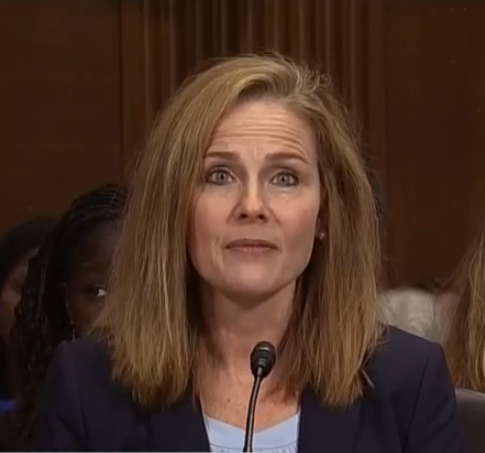
Justice Amy Coney Barrett told the lawyer, “There is a sense of unfairness, I think, to the plaintiffs, because they just never get the opportunity to appeal or to try to remedy this wrong.”
Justice Sonia Sotomayor said Whole Foods “was dismissed erroneously” from the litigation.
Justice Neil Gorsuch told Harrington that her side created a problem “through an improper removal. I mean, in terms of fairness … your hands aren’t exactly clean here.”
The Palmquists’ attorney, Russell Post, told the justices that a federal court cannot gain jurisdiction over a case “through error.”
“Federal courts are courts of limited jurisdiction, and the obligation to respect those limits is inflexible and without exception,” he said.
Justice Clarence Thomas told Post, “This would be a lot cleaner [of a] case if you had appealed the dismissal. Why didn’t you?”
Post said Supreme Court precedent holds that there is “no obligation to seek immediate review to preserve the right to an ultimate appeal on this issue.”
The high court is expected to issue a ruling in the case by the end of June 2026.
This article by Matthew Vadum appeared Nov. 4, 2025, in The Epoch Times.
Photo: Amy Coney Barrett