
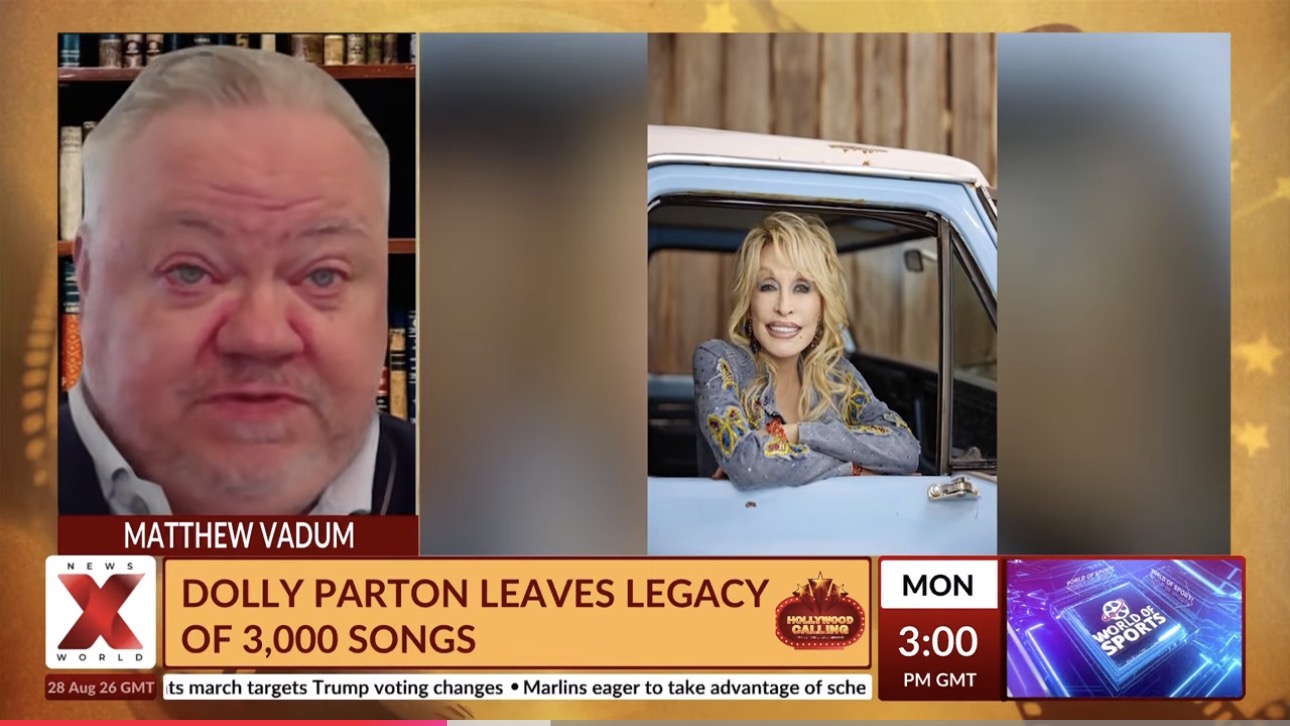

Investigative journalist Matthew Vadum discussed the death of Dolly Parton on NewsX World’s Hollywood Calling on Friday, August 28, 2026. The segment was anchored by Sukanya Saha.
Watch:
Parton died in Nashville on August 25 at 80 after a brief battle with cancer. The country songwriter, actress, and philanthropist had been a fixture of American life for six decades. Vadum said that was exactly why her death landed harder than expected.
“I can’t remember a time when there wasn’t a Dolly Parton,” he said. “I just took her for granted like most people here in America. And I was quite surprised that I actually had feelings about her when she died.”
“She was a rare American figure. She was a poor girl from the Appalachian region known for grinding poverty and coal mining… and she became basically a national possession of the American people without becoming, like many celebrities, preachy and partisan.”
That, Vadum said, was the point. Journalists pressed her for political commentary. She declined.
“She studiously avoided that,” he said. “She said it was her job to be an entertainer, not to be a political activist.”
On the fortune she did not die with, he used the number that keeps coming up: an estimated $450 million. She could have been a billionaire.
“She probably would have died a billionaire, but she kept giving much of her money away. She was a very generous figure.”
Asked what living artists should take from that, Vadum did not lecture Hollywood about charity. Plenty of rich celebrities already write checks. The rarer habit was restraint.
“A lot of them would be well-advised to not get political,” he said. “So many of them today jump on the bandwagon with trendy causes and start mouthing off and offending a lot of people who would otherwise be their fans.”
He also talked about the look people mocked in the 1960s and 1970s — the hair, the rhinestones, the figure — and the way she took the punchline away from them.
“It costs a lot of money to look this cheap,” he said, quoting her. People asked how long it took to do her hair. “A lot of people put a lot of work into my hair, but I’m not there to see it.” She wore wigs. She joked about them onstage.
“She had a very healthy sense of humor,” Vadum said.
“She’s a ubiquitous figure in American culture, and she’s very hard to avoid. She’s always there.”