
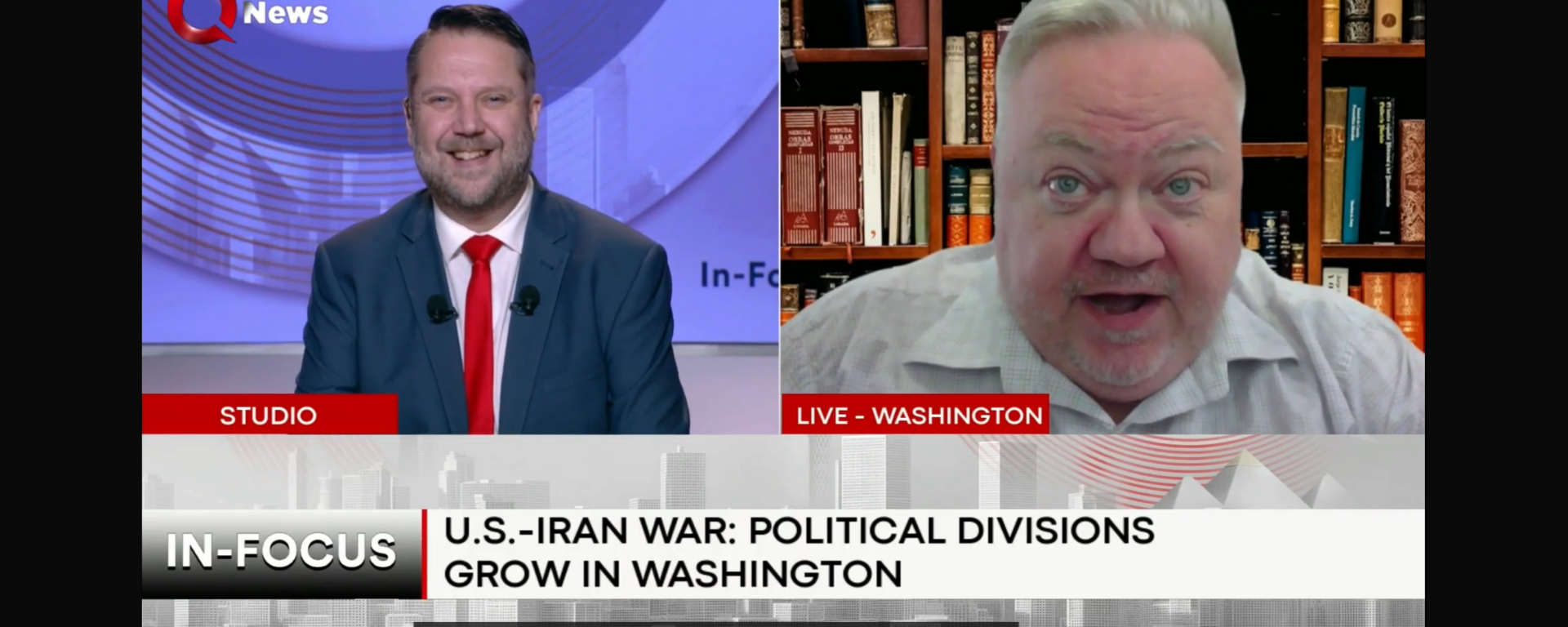

Investigative journalist Matthew Vadum appeared July 17, 2026, on Cairo-based QNews, an English-language network, discussing U.S. political dynamics amid the Iran conflict, President Donald Trump’s recent address, congressional budget/funding debates, and election security. The anchor was Mark Somers.
Vadum said the Iran situation is reshaping Washington politics, noting it barely came up in Trump’s TV address the previous night (July 16). The speech focused mainly on election security, potential voter fraud, and Chinese spying on the U.S. electoral system. He described intra-Republican tensions in Congress over Iran war funding: “war hawks” want full support for the president’s budget requests, while others back the war in principle but worry about costs, seeking offsets or cuts due to overall government spending. Vadum characterized this as normal “push and pull” for an unpopular foreign conflict lacking broad public support.
The discussion shifts to midterm election risks. Vadum said Republicans are polling poorly and appear likely to lose the House (potentially leading to more impeachment efforts against Trump), though Senate control is less certain since only one-third of seats are up for election in November. Voters’ top concerns are economic “pocketbook issues.” Vadum addressed Democratic fears (amplified by figures like lawyer Marc Elias) that Trump might use the speech as a pretext to interfere in November elections (e.g., via emergency measures or armed personnel at polls). He downplayed this as overblown, emphasizing limits on presidential power—states administer elections, Trump can’t legislate by executive fiat, and drastic steps would likely be seen as overreactions even by many Republicans.
Vadum also covered Trump’s push to link Iran funding with the proposed SAVE Act via budget reconciliation (bypassing the Senate’s 60-vote filibuster threshold for a simple majority). The SAVE Act would require proof of U.S. citizenship for voter registration and photo ID for in-person voting, while cracking down on mail-in voting (which Republicans view as fraud-prone and Democrat-leaning). Vadum noted challenges, including Senate procedural hurdles and opposition from some Republicans (e.g., Senate Majority Leader John Thune), despite the bill’s popularity with the GOP base.
Another guest, Nicholas Williams, a former NATO official, highlighted international stakes like potential Strait of Hormuz/Red Sea disruptions, economic shocks, and European caution.
The below two video clips overlap.
Here is the first clip:
And here is the second clip: