
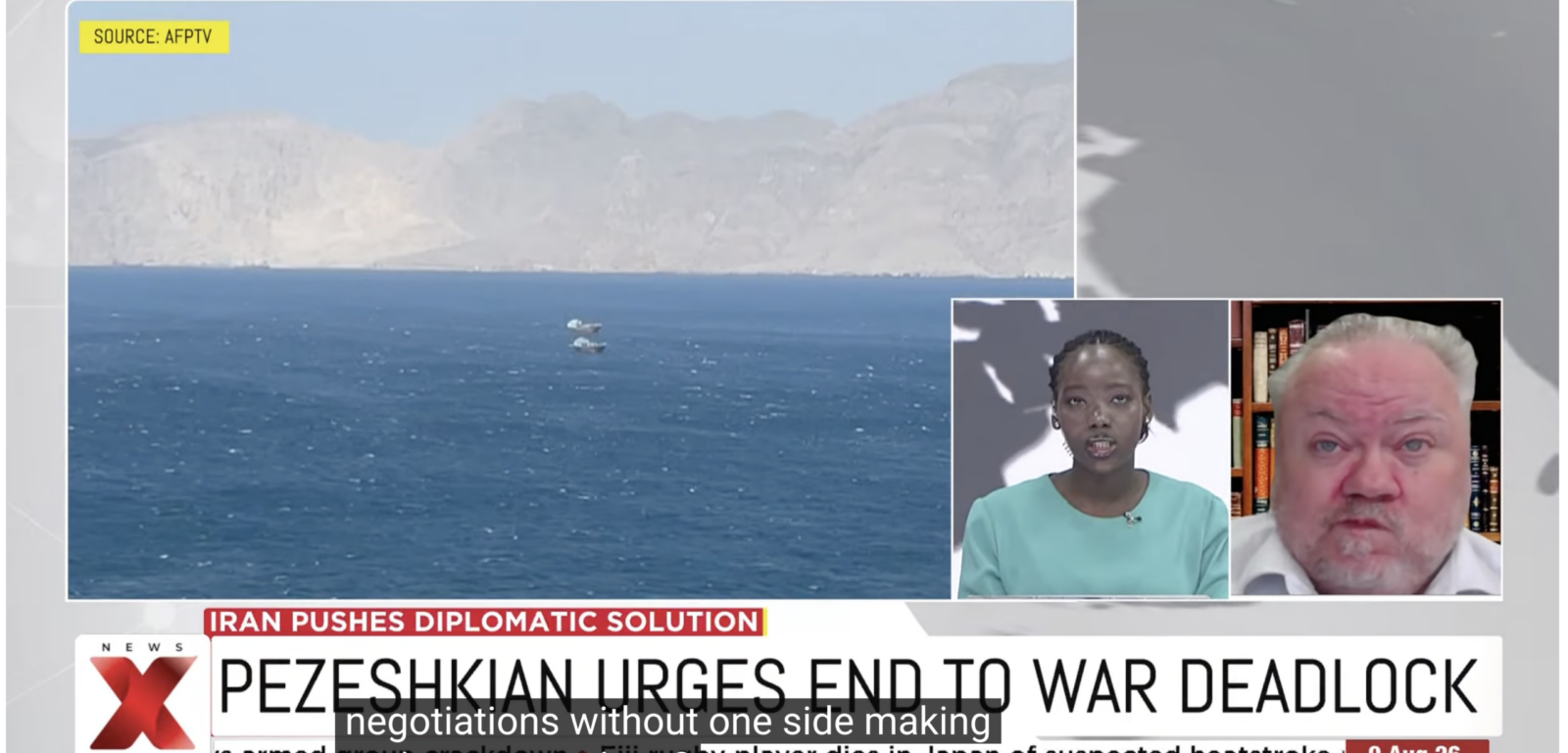

Journalist Matthew Vadum appeared on NewsX World on August 8, 2026 (August 9 in India), to discuss three major international developments: Iranian President Masoud Pezeshkian’s call to move beyond a state of “neither war nor peace,” Ukrainian President Volodymyr Zelenskyy’s claims of massive damage to Russian energy infrastructure, and the telephone conversation between Indian Prime Minister Narendra Modi and U.S. Vice President JD Vance. The anchor was Keren Nanyaro.
The segment is available here:
Iran
Addressing Pezeshkian’s statement that Iran must exit its current limbo, Vadum stressed the limits of the Iranian presidency.
“In the Iranian system, the president is closer to a weak prime minister than a Western-style chief executive,” Vadum said. He noted that Pezeshkian depends on Supreme Leader Mojtaba Khamenei and the Islamic Revolutionary Guard Corps for authority.
Vadum interpreted the remarks as a signal that Iranian leaders want an off-ramp from intermittent conflict, sanctions pressure, and incomplete diplomacy. They prefer a negotiated arrangement based on the June memorandum of understanding with the United States, “provided that it does not require them to dismantle their defensive capabilities or accept what they consider to be humiliation.”
He described the statement as “damage control” and an attempt to show “flexibility on the process while holding firm on the substance.” Vadum cautioned that “actions mean more than words, especially when you’re dealing with people as slippery and wily as the Iranian leadership.”
Ukraine
On Zelenskyy’s claim that Ukrainian strikes have inflicted “trillions of roubles” in losses on Russian energy infrastructure, Vadum said the campaign has been in effect for some time already.
“I don’t think this is a change in strategy. This is what Ukraine has been doing for a while,” he said. “Ukraine has been carrying out a sustained long-range campaign against Russian oil refining and energy infrastructure.”
While acknowledging that the precise figure is difficult to verify, Vadum said the mega-rouble claim is “directionally correct.” He framed the core strategic question as whether these strikes impose enough economic pain to alter Russian calculations, or whether Moscow can absorb the losses while continuing to degrade Ukraine’s energy system and front-line forces.
India and the Modi-Vance Call
Vadum also analyzed the August 8 phone call between Prime Minister Modi and Vice President Vance, which came amid U.S. legislative pressure on countries buying Russian oil.
He said India is “anxious to repair” and improve a recently tense relationship with the United States. In President Trump’s second term, Washington has been “pretty brutal in levying tariffs against a friendly country, India.”
Vadum suggested the call’s purpose was to firm up bilateral ties, with the birth of Vance’s son providing a natural opening. The leaders discussed trade, defense, critical and emerging technologies, energy security, and critical minerals as part of efforts to deepen the India-U.S. Comprehensive Global Strategic Partnership.
“Prime Minister Narendra Modi’s hope is that the United States starts going easier on India in terms of the tariffs,” Vadum said. “He’s putting his best face forward and trying to limit the damage.”
The full appearance is available above.