
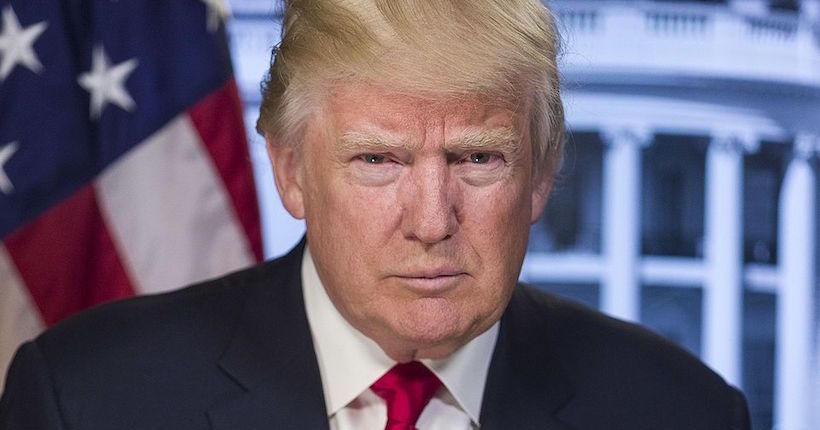

President Donald Trump said on Nov. 2 that he no longer plans to attend this week’s Supreme Court oral arguments about his reciprocal tariffs.
The president was referring to the hearing the high court is scheduled to have on Nov. 5 in two consolidated cases known as Learning Resources Inc. v. Trump and Trump v. V.O.S. Selections Inc. On Sept. 9, the court agreed to expedite review of lower court rulings that struck down most of the president’s global tariffs.
The levies being challenged are reciprocal tariffs imposed on imports from other countries to match the tariffs and other trade barriers that they already impose on U.S. exports.
Although sitting presidents don’t normally attend Supreme Court arguments, Trump had said on Oct. 15 that he would be in the audience for the argument of “one of the most important cases ever brought.”
If the tariffs are struck down, “it’ll be a disaster for America,” he said at the time.
“That’s why I think I’m going to go to the Supreme Court to watch it. I’ve not done that, and I had some pretty big cases. This is … one of the most important cases ever brought, because we will be defenseless against the world.”
However, on Nov. 2, Trump told reporters aboard Air Force One that he had decided against attending because he didn’t “want to call a lot of attention to me. It’s not about me, it’s about our country.”
“I’ll be going to Miami and make a speech in front of a large group of people in Miami, and said I wanted to go so badly. I just don’t want to do anything to deflect the importance of that decision.”
Also on Nov. 2, Trump posted on Truth Social about what effect the Supreme Court’s eventual ruling in the case might have on the country.
“It will be, in my opinion, one of the most important and consequential Decisions ever made by the United States Supreme Court,” he wrote.
“If we win, we will be the Richest, Most Secure Country anywhere in the world, BY FAR. If we lose, our Country could be reduced to almost Third World status—Pray to God that that doesn’t happen!”
The president has made tariffs the centerpiece of his foreign policy in his second administration, saying they may be used to encourage manufacturing to return to the United States. He has also said that the tariffs may help correct what he considers unfair trade practices that countries that export goods to the United States are engaged in, as well as to curb the illegal flow of fentanyl into the country.
Although the lower courts found that Trump lacks authority under the federal International Emergency Economic Powers Act to impose the country-specific tariffs that he unveiled earlier this year, enforcement of their rulings was put on hold, and the tariffs remain in effect for the time being.
In the case of Learning Resources, an Illinois-based maker of educational toys, a federal district court on May 29 granted a preliminary injunction blocking the tariffs.
That court held that the International Emergency Economic Powers Act that Trump cited in issuing the tariffs does not allow the president “to unilaterally impose, revoke, pause, reinstate, and adjust tariffs to reorder the global economy.” The tariffs present “an existential threat” to the company’s business, the court also determined.
In the case of V.O.S. Selections, a New York-based importer of alcoholic beverages, a divided U.S. Court of Appeals for the Federal Circuit held that the bulk of Trump’s reciprocal tariffs were unlawful and that the president exceeded his lawful authority when enacting them.
The U.S. Court of International Trade previously held that the president improperly used his emergency powers to enact the tariffs.
The Federal Circuit Court majority similarly found that the president went beyond his authority when he invoked the International Emergency Economic Powers Act.
Trump’s comments came after the U.S. Senate passed two measures in recent days to curb tariffs the president has issued.
On Oct. 30, the Senate voted 51-47 in favor of a joint resolution, S.J. Res. 88, to revoke the national emergency declaration Trump used as the legal basis for his reciprocal global tariffs.
On Oct. 28, the Senate voted 52-48 for a bill that would repeal the president’s 50 percent tariff on Brazilian imports entering the United States.
A similar action is unlikely to pass the Republican-majority House.
Andrew Moran contributed to this report.
This article by Matthew Vadum appeared Nov. 3, 2025, in The Epoch Times.