
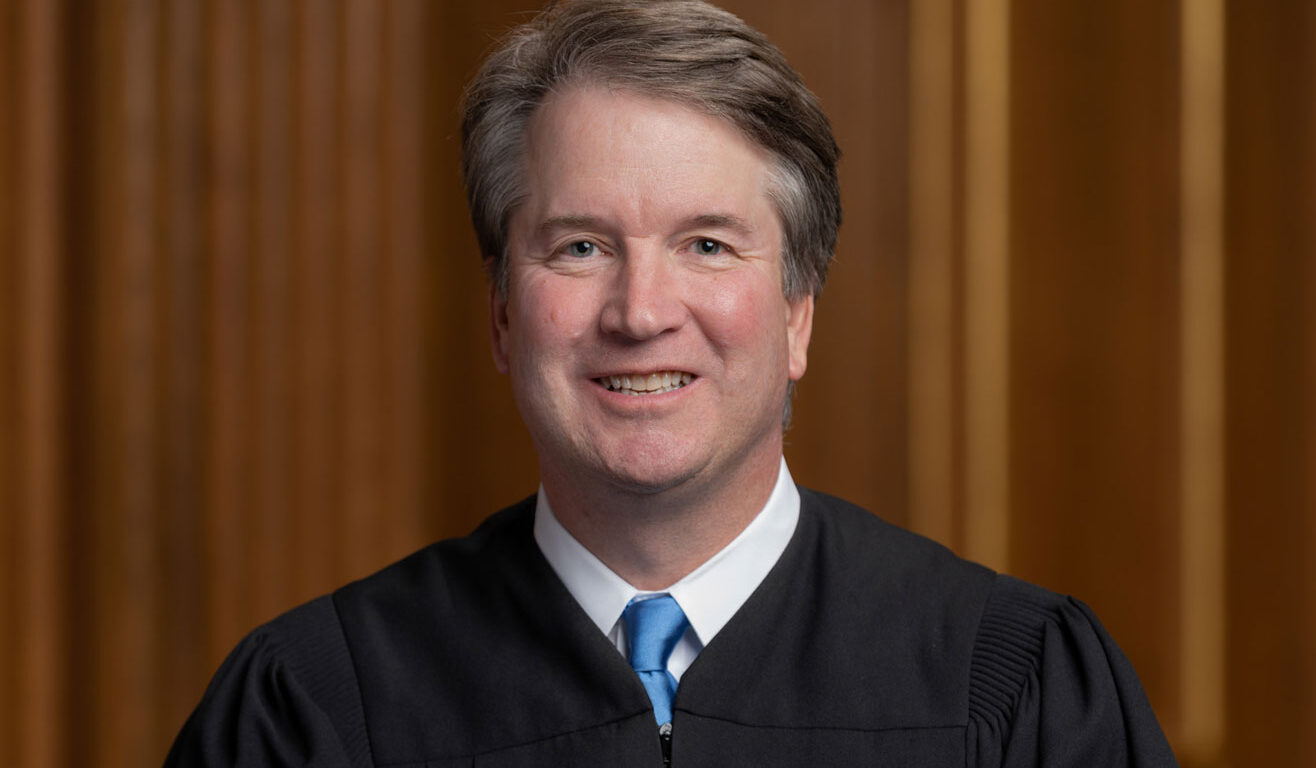

The Supreme Court grappled with federal limits restricting political parties from coordinating spending with candidates during oral arguments on Dec. 9.
Limits on spending coordinated between party committees and candidates were created on the theory that not having them encourages corruption and allows wealthy donors to have outsized influence.
Congress enacted the Federal Election Campaign Act in 1972 to limit spending and fundraising in campaigns for federal political office, amending it in 1974 to limit how much political party committees may accept and spend to influence a federal election.
The case, National Republican Senatorial Committee (NRSC) v. Federal Election Commission (FEC), is NRSC’s challenge to provisions of the Federal Election Campaign Act.
The petitioners are the NRSC, the National Republican Congressional Committee, Vice President JD Vance, and former Rep. Steve Chabot (R-Ohio). The respondent is the FEC.
A divided U.S. Court of Appeals for the Sixth Circuit ruled against the petitioners in September 2024, finding that because the Supreme Court never reversed a landmark 2001 decision known as FEC v. Colorado Republican Federal Campaign Committee, the limits remained constitutional.
Although the appeals court determined that coordinated party expenditure limits were inconsistent with recent Supreme Court rulings on the First Amendment, it upheld them, finding that the issue was controlled by the still-binding 2001 precedent, according to the NRSC’s petition.
In the 2001 ruling, the high court held that party-coordinated expenditures, unlike party expenditures given independently of any candidate or campaign, may be limited by law to “minimize circumvention of [individual] contribution limits.”
One argument of those who support the coordination limits is that they discourage corruption. The argument is that because federal law allows larger donations to political parties, as opposed to candidates, curtailing the limits would allow donors to accomplish a quid pro quo with candidates by giving to their party. A quid pro quo is something given or received in exchange for something else.
During the oral argument on Dec. 9, NRSC attorney Noel Francisco said “the coordinated party spending limits are at war with this court’s recent First Amendment cases.”
“No one has identified a single case in which a donor has actually laundered a bribe to a candidate through a party’s coordinated spending, even though 28 states allow it,” he said.
Justice Clarence Thomas raised the issue of whether the case might be moot because co-petitioner Vance, who has not clearly indicated if he will run for president in 2028, had standing to file the lawsuit. Standing refers to the right of someone to sue in court. The parties must show a strong enough connection to the claim to justify their participation in a lawsuit.
“With respect to the vice president, what does he mean when he says, in effect, that it was too early to decide whether or not to run?” Thomas said.
Francisco said Vance is waiting until after next year’s midterm elections to announce what he plans to do, which is “what virtually every candidate for the presidency does.”
To demonstrate mootness, the other side would have to show that Vance “has actually abandoned his intentions to run for federal office,” the lawyer said.
Attorney Roman Martinez, whom the Supreme Court appointed to defend the Sixth Circuit decision because the Trump administration declined to do so, suggested Vance may not have standing in the case.
“Vance’s lawyers are basically telling you, ignore what he’s saying publicly, don’t believe them, wink, wink, nod, nod, don’t be naive—we all know he’s really running,” Martinez said.
Justice Samuel Alito replied, saying, “Are you serious?”
Martinez said, “I’m serious that the same rules have to apply to all plaintiffs.”
Justice Brett Kavanaugh said he was “concerned” that current laws, as interpreted, have hindered the ability of political parties to function.
Supreme Court rulings on campaign finance have “reduced the power of political parties as compared to outside groups, with negative effects on our constitutional democracy,” the justice said.
Francisco said there are rules in place to discourage corruption.
“The donor who’s trying to bribe a single candidate has to go through the party who’s trying to get elected lots of candidates and hope that … the party spends that money on behalf of the candidate that the donor is trying to bribe,” the attorney said.
Many candidates run unopposed or have slight chances of winning or are in safe seats, Francisco said.
“Parties don’t want to spend money on behalf of those candidates. So, if I’m trying to submit a bribe to bribe that candidate, it’s not likely going to get through to the candidate at the end of the day. And if it does, it’s going to be pretty blazingly obvious.”
Democratic National Committee attorney Marc Elias said, “the practical effect of [the] petitioners’ case would be to convert the political parties into mere paymasters to settle invoices from campaign vendors.”
Justice Amy Coney Barrett asked why the RNC and DNC, which had long been aligned on the coordination issue, no longer agree.
Elias said he disagreed with the claim that the two political parties had been aligned on the issue.
Justice Sonia Sotomayor suggested that laws are needed to prevent the appearance of corruption.
She said to Francisco, the NRSC attorney, “You mean to suggest that the fact that one major donor to the current president, the most major donor to the current president, got a very lucrative job immediately upon election from the new administration, does not give the appearance of quid pro quo?”
Sotomayor did not identify the individual to whom she was referring.
Francisco replied, saying: “I’m not 100 percent sure about the example that you’re looking at, but if … I think I know what you’re talking about, I have a hard time thinking that his salary that he drew from the federal government was an effective quid pro quo bribery, which may be why nobody has even remotely suggested that.”
“Maybe not the salary, but certainly the lucrative government contracts might be,” Sotomayor replied.
This article by Matthew Vadum appeared Dec. 9, 2025, in The Epoch Times.
Photo: Supreme Court Justice Brett Kavanaugh