
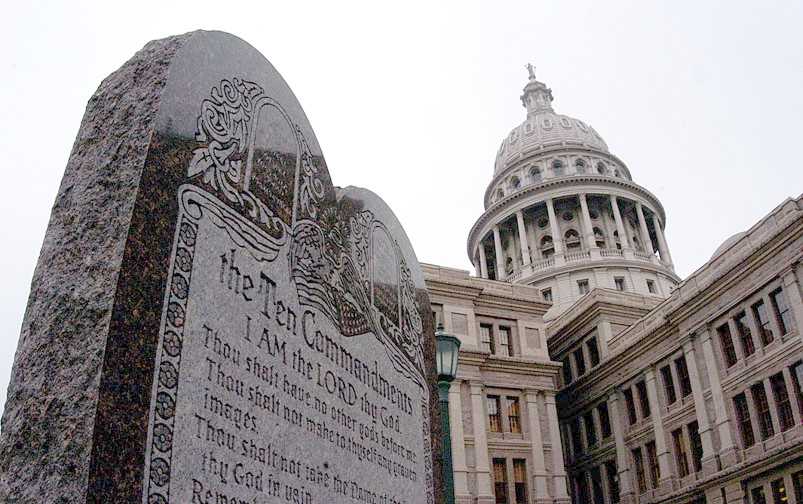

A federal appeals court has upheld a Texas law requiring the display of the Ten Commandments in public school classrooms.
In a 9–8 decision, the U.S. Court of Appeals for the Fifth Circuit said in Nathan v. Alamo Heights Independent School District that the law complied with the First Amendment, despite a contrary ruling it issued last year.
If the case reaches the nation’s highest court, the subsequent, potentially landmark ruling could change the legal landscape for how governments deal with religion.
Here’s what to know about Texas’s law and broader legal questions around displaying the Ten Commandments:
Appeals Decision
The Texas law requires that public elementary and secondary schools conspicuously display in classrooms an easily readable poster or framed copy of the Ten Commandments with no additional commentary.
The judge eventually blocked Texas’ law while citing court decisions on two other Ten Commandments laws—one from Louisiana and one from Kentucky.
That decision, which the Fifth Circuit said was binding on lower courts, held that Kentucky’s Ten Commandments law violated the Establishment Clause because it lacked a secular educational purpose. It also affirmed the Supreme Court’s so-called Lemon test, which found a law related to religion must have a secular purpose to be constitutional.
Because both Texas and Louisiana are within the Fifth Circuit, both are bound by its decisions.
Texas, rather than Louisiana, is likely headed to the Supreme Court because the Fifth Circuit later rejected its own decision on the latter state law. It reheard the Louisiana case en banc, or with the full court. When it did, the Fifth Circuit said that decision was premature, noting that the displays hadn’t been installed in Louisiana classrooms.
The Fifth Circuit’s more recent decision from April also came from the full court rather than a three-judge panel. When the circuit reviewed the law, it disagreed with the judge who blocked the law. The circuit found the statute did not violate the establishment or free exercise clauses.
It also said the Supreme Court had since discarded the reasoning it used in the Stone v. Graham case.
First Amendment
The judges in the case disagreed on the relevance of the Lemon test, a legal doctrine established by the Supreme Court in Lemon v. Kurtzman (1971). In that case, the Supreme Court held that state funding for private religious schools violated the Establishment Clause.
The high court found that reimbursing religious schools created “excessive entanglement” with religion because government oversight would be needed to ensure taxpayer funds weren’t spent on religious instruction. A law that either advanced or hindered religion was unconstitutional, the justices ruled.
The court found the law improperly favored Christianity, interfered with parents’ right to direct their children’s religious upbringing, and likely violated both the establishment and free exercise clauses.
The judge wrote an unconventional opinion illustrated with historical photographs and a still image from a Hollywood movie. The opinion cited Stone but also quoted the challengers’ argument that the version of the Ten Commandments required was distinctly “Protestant.”
The ruling also recounted past religious strife between Protestant and Catholic Christian sects. The court suggested that if a government “joined hands” with religion, it could impose whatever religious views it favored, ranging from Mormonism to Judaism to Islam.
The Fifth Circuit on April 21 reversed on a 9–8 vote, finding that the Texas statute does not violate the establishment or free exercise clauses.
Instead of relying on Lemon, courts should apply a history-based analysis, asking if the law resembled “a founding-era religious establishment.” Courts need to look at historical sources and scholarship, the appeals court said in Kennedy.
The Texas law “looks nothing like a historical religious establishment,” because it does not tell houses of worship what to believe, how to worship, or whom to employ. It does not punish people who reject the Ten Commandments, impose taxes to support the clergy, or require churches to carry out civic functions, the appeals court said.
“These are the kinds of things ‘establishments of religion’ did at the founding. [The Texas law] does none of them.”
A dissenting opinion in the Texas case said the appeals court should have followed precedent and that Stone had never been formally overturned by the Supreme Court.
Potential Supreme Court Decision
The American Civil Liberties Union and other groups challenging the Texas law said they would appeal the Fifth Circuit decision to the Supreme Court.
David Super, a professor at Georgetown University Law School, said he “strongly suspects” the court will accept the case, after the Fifth Circuit had “clearly” been trying to push the high court “to accelerate its transformation of the religion clauses.”
The circuit court “took the highly unusual step of declaring a Supreme Court precedent to have been overturned when the Supreme Court itself had not done so,” he told The Epoch Times.
The Supreme Court may find it “troubling” that the Fifth Circuit is saying legislation is allowed unless “the historic record shows similar legislation being struck down in the founding era,” Super said.
Garrett Bell, associate counsel at First Liberty Institute, was unwilling to predict if the Supreme Court will take the case, but said the Lemon test is “dead.”
In Kennedy v. Bremerton, the court held the establishment clause has to be interpreted by reference to “historical practices and understandings,” Bell told The Epoch Times.
In a previous Fifth Circuit case called Freedom from Religion Foundation v. Mack (2022), that court pronounced the Lemon test dead, saying “its long Night of the Living Dead is now over,” Bell said.
Richard Mast, senior litigation counsel at Liberty Counsel, said if the Supreme Court wished to provide legal certainty, it may take up the case, and if it did, it would uphold the Texas law.
“The Lemon test is dead–100 percent,” he told The Epoch Times.
This article, an explainer, by Matthew Vadum, appeared May 3, 2026, in The Epoch Times.
Photo: Ten Commandments display at the Texas State Capitol in Austin. Photo by Office of the Attorney General of Texas (public domain)